The Immortal Kiki and Herb Conquer New York Again

photo by Kevin Yatarola.
On Wednesday, Kiki and Herb: Seeking Asylum! will wrap up its triumphant return at Joe’s Pub here in New York City. These intensely beloved characters, the cabaret noms de plume of Mx. Justin Vivian Bond and Kenny Mellman, have played all over the world at various points in the past two decades, but for longtime fans like myself, the show is forever tied to a mostly bygone era of downtown New York.
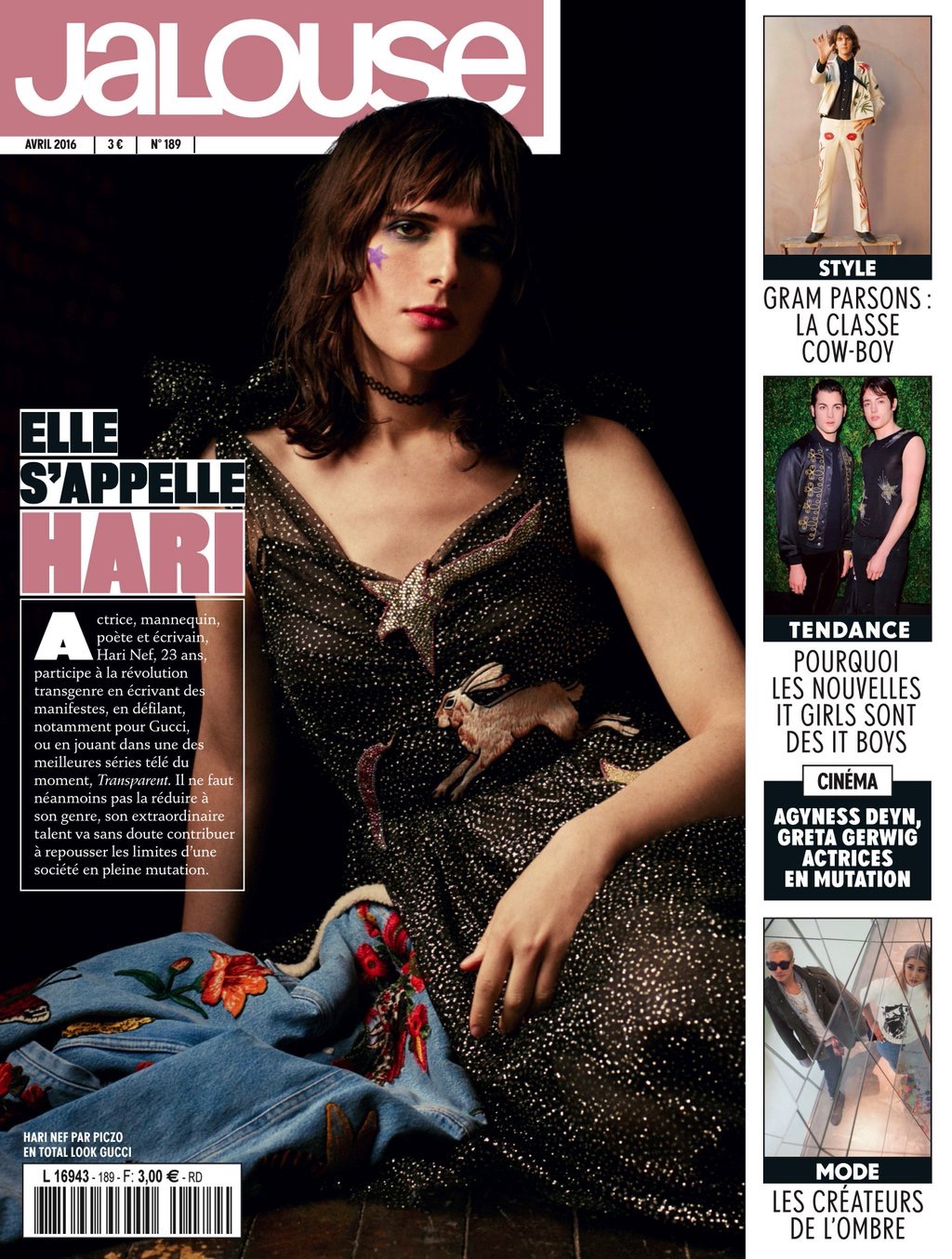
Hari Nef: Model, Actress, Muse

from Issue 189 of Jalouse
It’s been a rollercoaster year for Hari Nef. In May of 2015 the 23 year-old actress and model signed a contract with IMG Models (the very same month she graduated from the theater program at NYC’s Columbia University) , making her the first transgender model signed to their roster. She has set runways alight for the likes of Adam Selman, VFiles, and Gucci while her writing on sex, gender, and identity graced the pages of Dazed, Vice, Blackbook and Adult. Just as her star in the fashion world and her reputation as the new doyenne of downtown NYC continued to rise she was cast in the second season of Transparent, tackling the role of a tragically doomed German cross-dresser with incredible aplomb that it appeared as if the role had been written especially for her (and it was). Though she is happy to serve as both an inspiration and muse for trans people everywhere, she is quick to point out that there is much more to her appeal than just her gender and her almost preternatural sense of style. “I have a lot more to offer to you than an identity and a body,” she says. “I have perspective and I have talent-- those exist on their own.”
T Cole Rachel: Were you a super performative kid? Did you always want to be an actress?
Hari Nef: Oh yes. I'm still a super performative kid. I always wanted people to understand me and feel what I was feeling and see what I was seeing. I guess performativity was just something that I sort of harnessed to translate myself to all of these people I had in my life.
Rachel: You’ve been very open about your experiences as a trans woman and I’m sure there is a certain amount of pressure on you to be a representative of the trans community. For trans people in the public eye, there is always this intense fixation on gender and presentation. Is it your hope that eventually people will start to fixate less on that part of your life?
Hari Nef: I hope it will. I'm just happy to be here, happy to be working. If people are still asking me the same things that they're asking me now in five years, I'm going to start to get a little worried, because I'm going to be bored. And I hope that this becomes boring for people. I hope that after a certain amount of education and discourse is sort of disseminated throughout the world that we can move forward, because everybody is asking me these questions under this supposition that we need to educate people, and I believe that's true. We need to deconstruct stigmas about bodies and identities. I don't feel like it's going to happen overnight, but at the risk of sounding arrogant, I'll say I have a lot more to offer to you than an identity and a body. I have perspective and I have talent, and those things--while perhaps inextricably informed and enmeshed in my lived experiences as a trans woman and many other myriad identities I carry-- those exist on their own. I'm a trans model, I'm a trans actress. I'm also a model and I'm also an actress.
Rachel: As trans people continue to become more visible in popular culture, there’s a hope that one day it won’t be seen as such an anomaly.
Hari Nef: I feel like as the word transgender is starting to be defined for people by popular culture, but If you're only looking at five people to represent an entire community, you need to understand that there are armies of people on the trans spectrum that do not resemble these folks that are your reference points, that do not have the same lived experiences as your reference points, who do not identify along the same gender binary as your reference points. Being trans is not about, "I was born one way but now I identify as another way." It's really about this idea of gender fluidity and being able to look at someone who is gender variant to any extent and affirm their identity. It's not just about binary trans women, or binary trans men, or people who have medically transitioned or had certain either feminizing or masculinizing procedures or whatever. It's less about the people you're seeing and more about the way you see people.
Rachel: Thinking about this past year, what have been the biggest surprises for you?
Hari Nef: Things that have happened to me or things that I've done, like signing a worldwide modeling contract with IMG, making my acting debut on Transparent, walking the Gucci show. I never expected that any of this would happen to me. Maybe there was a certain sense that I thought that maybe I could take my talent somewhere, but especially after coming to terms with my gender identity and a lot of the pain that was associated with that, all of my dreams came true right at the moment I was sort of becoming comfortable with giving up on my dreams. Understanding that my gender variance is probably going to make things very difficult for me, and understanding that there were so few precedents for people with my body and my identity doing the things that I wanted to do, that I should never ever bank on doing them…and then a bunch of them happened anyway. That was the biggest surprise, because I didn't expect it and neither did anybody else. Before I signed with IMG, every other agency--literally every other one--either wouldn't even meet with me or just straight up wouldn't sign me. This was not a sure thing, for anybody, much less me. Just the fact that I'm even sitting here is a surprise to me still.
Rachel: In terms of acting, do you have a dream project?
Hari Nef: I would love to play Lady Macbeth. I would love to play Stella in A Streetcar Named Desire. I would love to play Candy Darling in a biopic. Or Patti Smith! There are dream roles out there, but because I don't bank on getting those roles, my big dream is to write for myself and to create a role that I can embody. I feel and think this a lot of the time, but a lot of my fellow trans girls just say it straight up, "None of this shit is made for us. These clothes aren't made for us, these movies aren't made for us, this shit is not made for us, and people don't want us around." They look at me and say, "Okay, little Ivy League white girl, you got through the door, good for you. We love you, but your inhabiting this space doesn't necessarily mean that they want any more of us in there than there already are." So I try to have an open heart about my collaborations, but there is a part of me that has these voices going through me, that none of this shit is made for me. Sometimes you have to make something for yourself.
Actor Max Martini Thinks We Need More 'Authentic Men' in His Business

Photo by Michael Muller
In addition to having one of the greatest names ever, actor Max Martini happens to have one of the greatest faces—handsome, strong, and the kind that can easily disappear into almost any role. He’s made a name for himself playing tough guys, notably in Saving Private Ryan and Pacific Rim, and now he continues the streak with Michael Bay’s 13 Hours: The Secret Soldiers of Benghazi. In the movie, Martini portrays Mark “Oz” Geist, one of the security contractors who risked his life defending the diplomatic compound in Libya. “Most men fantasize about being heroic,” the actor says. “I know Hollywood paints me to be a badass, but Mark is the real deal. His bullets were real—mine aren’t.”
Le1f On The Life Lessons That Led To His Debut Album, 'Riot Boi'

Photo by Eric Johnson
Anyone trying to discover what New York City sounds like circa right this very minute need look no further than Le1f, the N.Y.C.-based rapper, producer, and dancer who has spent the past few years transmuting the city’s energy into his own specific blend of queer hip-pop. The musical nom-de-plume of twenty-six year-old Khalif Diouf, Le1f has been releasing singles and remixes intermittently for the better part of a decade now. His debut mixtape, Dark York, garnered raves back when it was released back in 2012, setting the stage for what would a long and arduous journey towards his first studio album. Given the breadth of Le1f’s vision on Riot Boi, out today on Terrible Records/XL Recordings—a sonic palette that includes futuristic rap, deconstructed R&B, and nods to industrial grime and vogue-appropriate house—the past three years has clearly been time well spent.
Callum Turner
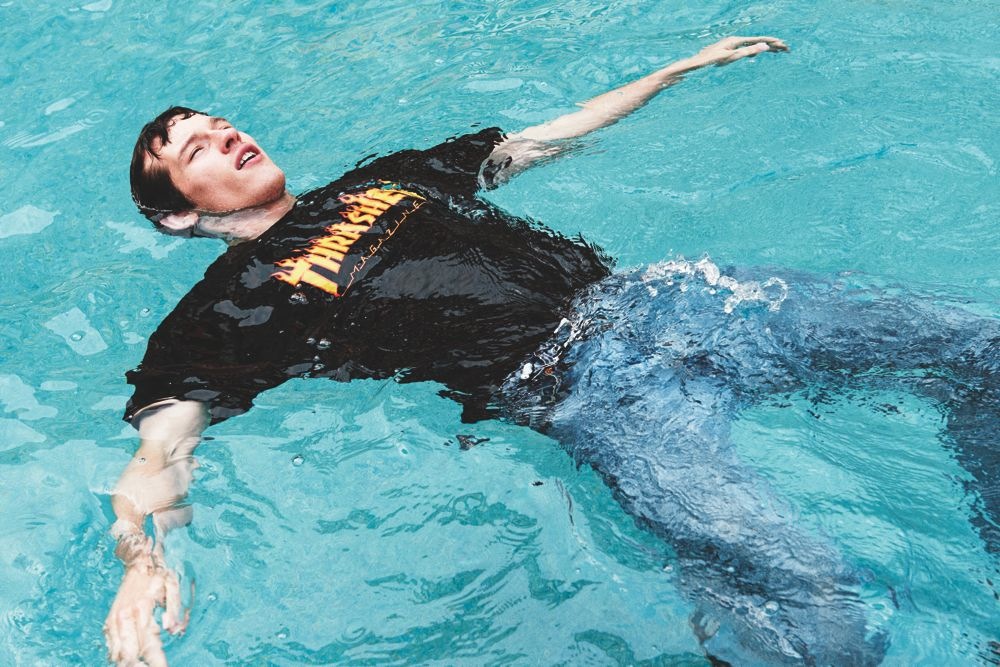
Photo by Dominick Sheldon
When first speaking with Callum Turner in person, it's hard not to be hypnotized. The 25-year-old English actor and model has the effusive, unassuming charm and awkward good looks that make him believable as a wistful young soldier, a terrorized punk rocker, or a married woman's paramour—all roles in which he's recently excelled. Meeting up at a quiet bar in Brooklyn, Turner exudes the unbridled enthusiasm of someone just coming into his own as an artist. "Today was so surreal," he says. "I'm in New York City, and I spent the day floating around in a pool with my clothes on. Now I'm here with you in a bar, and later I'll try to learn to speak Polish for my next movie role. Like, what is this? What's happening?"
John Lydon: The lead singer of the Sex Pistols on losing his memory and finding his mojo

It’s hard to imagine what the landscape of popular music would look like without John Lydon. As the front man of the Sex Pistols, Lydon is forever emblazoned in the cultural lexicon as Johnny Rotten—the spitting, snarling antithesis to everything establishment and the forever face of punk rock. While his “Rotten” past will always be a pivotal moment in the history of rock and roll, the now 59 year-old musician is quick to point out that he is still much more than a Pistol. Last year Lydon published Anger is An Energy: My Life Uncensored, a surprisingly sentimental autobiography that details Lydon’s tumultuous childhood (including a harrowing, coma-inducing bout of meningitis at age seven that caused him to lose his entire memory), his equally volatile life with the Sex Pistols, and a sprawling career filled with controversy, music, and various stints doing everything from stunting on reality television, hosting nature programs (“John Lydon’s Shark Attack!”) and the arguably very non punk rock act of hawking Country Life butter in TV ads. This fall Lydon returns with What The World Needs Now…, an excellent new album from his other iconic band, Public Image Ltd. Given his reputation as one of the world’s great loose canons, chatting with Lydon is predictably hysterical and radically honest.
T. Cole Rachel: You’ve spent a lot of time this past year out supporting your book. Were you surprised by the way people reacted to it?
Lydon: Generally, yes. It deals with all those things in my childhood I never really wanted to be brought out into the public eye until now. The reason being, of course, I didn't want to be accused of self-pity or going for the sympathy votes and that somehow, that would've helped my career. I've had a very long career here without all of that stuff and now it's like: here's what's really going on. Have a bang at this number, babies!
Rachel: I love that about it. I know this sounds kind of preposterous, but the book is also very humanizing. I think it makes people see you in a different kind of light.
Lydon: I hope so. I haven't always had the easy life, but I'm not moaning about that. There really is no self-pity. For me, the greatest achievement in my whole life was recovering my memory. What can I tell you? Having to endure those four years of being outside myself looking in when I was a child, wondering who I really was or indeed, who anyone was, or if I even belonged anywhere or to anyone. That set me up really kind of well for the future. Without that, I don't think I could've been quite the Johnny Rotten I turned in to. My greatest achievement was that and then the Pistols and P.I.L. were just like cherries on top of a dreadful, torturous cake.
Rachel: When people meet you for the first time, are they're expecting to have the full Johnny Rotten experience?
Lydon: Which should be what?
Rachel: I don't know. Scowling, cursing, ranting…
Lydon: When you read my book, you realize there's ever so much more to that cartoon characterization that the sensationalist media headlines implied. As indeed, of course, there had to be. Nobody can be that two-dimensional. My life is not a post card.
Rachel: I just wondered if that reputation ever felt burdensome to you.
Lydon: No. I've got to say that in all of it, the negativity included, that I've got a great sense of fun that somehow in my life, I’ve basically managed to offend everybody all at once.
Rachel: You’ve lived in the U.S for a very long time now. Could you imagine living somewhere else at this point or you feel like this is definitely your home?
Lydon: No, I don't want to live anywhere else. I was shocked that America accepted me. The only reason that the American government wouldn't allow me to be a citizen for such a long time was because of the British, who kept an open file on me under the Terrorism Act.
Rachel: This new P.I.L. record is your 10th release with the band. Has your process changed much?
Lydon: No, it’s pretty ad hoc. Fly by the seat of your pants and hope that all those conversations leading up to the actual recording process were valuable and indeed, they always are. You can't make a record like we do unless communication has gone on before--and I mean in-depth self-analysis. What it is we try to do is study the human emotions-all of them, the good and the bad-- and try to find some sense of value by being honest about these things. I suppose what I'm looking for, which is what I'm always looking for in other peoples' work, is transparency-that I can see straight through to what it is they're trying to communicate. Sometimes words don't do that enough for me. There aren't enough words that are capable of expressing completely the human emotions. Sometimes has to come with sounds, texture. That being said, the classical orchestra to me is incredibly boring. It's where is the humanity? For me, the first musical instrument in all of nature is the human voice.
Rachel: How do you feel about your own voice?
Lydon: It's a work in process. It's far from perfect, but then again, it doesn't need to be. It's accurate. It accurately portrays what I'm trying to get across in the sentiment of any particular song. It affects me a great deal, performing them live, some of these songs. I'm not just talking this album, but all the way through my P.I.L. years and some of these songs break me down on stage and I will go into a full-on cry because they're so close and personal.
Rachel: In your book you are very candid discussing your own self-doubts and your fears about letting other people down. A lot of people wouldn’t think that about you, given how outrageously self-assured you’ve always seemed.
Lydon: It'll always be there. A lot of people avoid the issues of self-doubt through, well, drugs like heroin-the greatest substitute for that, but nothing good comes out of you on drugs. You lose your soul. I found that fear and self-loathing and all of these things that are wrapped around self-doubt to be actually useful tools. What that is is your body and your mind telling you to get ready to deliver something genuine.
Rachel: Writing a massive memoir requires you to go back and really examine your life, for better or worse. Was that hard for you?
Lydon: Let's say I didn't do it with rose-colored glasses. It's painful sometimes, but it's there and it exists. I lost my memory for something like four years. That was very, very painful, that sense of isolation. I was a walking zombie and feeling I belonged to no one and I didn't know why. I resolved that and that's why I will never tell a lie to people. I can't stand it, because I know what it's like to have to endure a lie and believe in it because you're so desperate to believe in anything at all that anybody tells you in order to find yourself. Don't lie. Don't inflict that on your fellow human beings.
Rachel: You’ll be on tour for much of this year. Are you excited?
Lydon: Yes, I am. I really like to push myself to the utmost Nth degree and drive myself almost slavishly to make up for those periods of indolence, which some might call a holiday. It's an odd thing with me; I'm like the world's laziest workaholic.
Rachel: That's good though.
Lydon: That's the influence of mom and dad. My mom, she couldn't care if the house fell down around her, and my dad, he'd be up at 4:30 every morning, no matter what, and he'd have to be brushing or cleaning or banging about for some reason and then off to work. He'd come home and he'd do the same thing all over again and go to bed for four to six hours, at most, and back at it. I've got a bit of both of them in me. It's in time you recognize these things, but in particular, once they've died and you really see them in you. Your parents never really die, they're constantly in there. I know my mom and dad are constantly telling me, "Get up, you lazy cunt…and don't tell no lies!"
The original version of this story first appeared in Man of the World No. 13
Born Again as FATHER JOHN MISTY, singer-songwriter Josh Tillman is raising just the right amount of hell

Photographed by Emma Tillman
At a time when so much popular music seems to be literally made for children it’s refreshing to see an artist that is audacious enough to take on the messy business of complicated, adult-sized relationships. For singer and songwriter Josh Tillman—better known these days by his musical nom de plume, Father John Misty—the desire to explore the intricacies of human connection has proven revelatory. After years of toiling in relative obscurity and touring in the shadows behind other more established artists, the 34-year old musician found himself at an impasse. Bored to tears of the sensitive man-with-an-accoustic-guitar trope that felt unavoidably inherent in being a singer/songwriter, Tillman abandoned his previous approach and rechristened himself with the ministerial moniker of Father John Misty, a kind of alter ego that provided him with a creative rebirth. As a result, Tillman has become a kind of sex symbol for the indie-rock world—playing the part of the charmingly erudite louse that sometimes says bad things but ultimately means well, a jerky romantic who wears his heart on his sleeve and isn’t afraid to talk about fucking. He makes folk-inflected pop music that is both sprawling and, at times, incredibly intimate. More importantly, Tillman is making the admirable effort to actually speak the language of grown ups.
“I'm making music for adults,” says Tillman, calling from a tour stop in Lawrence, Kansas. “I know it sounds pedantic to say that, but at the same time it's shocking to me how many young kids are at these shows. I'm like, ‘Wow, you're not even going to know what these songs are about for another 10 years or something.’”
Adult-sized attention might be a relatively new thing for Tillman, but he is hardly new to the music business. He spent the better part of his twenties trying, in various guises, to make a name for himself as a songwriter. Having fled from the conservative confines of his evangelical childhood in Rockville, Maryland, Tillman eventually landed in Seattle. It was there that he would eventually spend the better part of the next decade quietly releasing eight full-length records of earnest singer/songwriter fare under the name J. Tillman--to very little notice. It wasn’t until he took on the job of drummer in Seattle indie-folk band Fleet Foxes in 2008 that his musical life began to radically change. Though he was essentially a hired gun in the band with little creative input (he eventually jumped ship from the band in 2012), the experience of touring the world emboldened Tillman to rethink his own creative ambitions. Thus, Father John Misty was born. His first album under the new moniker, 2012’s Fear Fun, proved to be a kind of sleeper hit, eventually charming its way onto lots of critical “best of” lists and turning Tillman into the indie-rock equivalent of a rock star.
“I've never been particularly sentimental about the past,” says Tillman of his early body of work. “To be honest, it was sort of surreal to plunge the knife into that 10-year body of work and just be like, ‘This is over, and something else has to grow where all of this is going to die.’ I'm ambivalent because I have some empathy for 21 year old me. I was just addicted to some fucking archetype. I was trying to embody something that just wasn't me. I think that for that period of time I was looking for a painless existence. I was trying to anesthetize my life, and I think that in my mind being a working singer-songwriter was going to cure my life. I was a kid, you know?”
Tillman’s most recent album--2015’s I Love You, Honeybear—is decidedly not kid stuff. Both beautiful and occasionally exasperating, It’s a record that balances a very tenderhearted narrative about romantic love (the album is essentially a document of Tillman’s courtship and eventual marriage to his now wife and frequent collaborator, Emma) and a kind of snarky indictment of all the things it is supposed to be celebrating. It is, as one Pitchfork critic described it, a record “so cynical it’s repulsive and so openhearted it hurts.” One of the album’s many pleasures is trying to decode where the joke ends and the sincerity begins. The album is packed with zinging one-liners and smirky delivery (“Mascara, blood, ash and cum / On the Rorschach sheets where we make love”), but Tillman isn’t kidding. At its core Honeybear an album about the ridiculous and amazingness of falling in love with someone and allowing yourself to really be seen by another person. (“Everything is doomed / And nothing will be spared / But I love you, Honeybear”) In a culture that seems increasingly only comfortable operating in absolutes, the fascinating slipperiness of Father John Misty is arguably Tillman’s greatest achievement.
Since releasing Fear Fun in 2012, Tillman has cultivated a formidable persona—equal parts modern day lothario and intellectual rogue whose work treads an almost invisible line between irony and sincerity. He is a showman—an artist prone to grand gestures and occasionally ham-fisted stage antics involving props and audience participation—but his music is imbued with a kind of emotional maturity that belies the fact that Tillman himself can occasionally be a clown (albeit, a sexy one). Not only are there very few other artists are writing as honestly or as ruthlessly about sex and love, it’s hard to imagine any of Tillman’s current indie-rock peers writing a song called “When You’re Smiling and Astride Me” and have it sound not only sexed-up, but deeply romantic.
“I could just start ranting and raving, but I do think that by and large songs about love are typically advertising some fantasy, some faith-based reality that doesn't exist,” says Tillman. “Love and companionship in this day and age is viewed almost strictly in term of compatibility. Is this other person going to be this source of constant amusement for me for the next 40, 50 years? Will we get bored? Will this person help facilitate a painless existence for me?”
Given the deeply personal nature of Honeybear’s subject matter, it’s understandable that Tillman initially had reservations about performing the record live. Now, deep in the middle of what looks to be another full year of nonstop touring, he seems to have come to terms with not only sharing his music (“The last time around, the shows could be sort of borderline antagonistic,” he says. “Because I was so skeptical of myself and skeptical of the whole enterprise. Thankfully that feeling ran its course”), but he also accepts the often conflicted way that people view him. Though he is quick to point out that there exists a difference between himself and Father John Misty, the question of sincerity—whether Tillman is doing something deeply satirical or if he really means it—remains somehow central to his appeal. The irony that Father John Misty might actually be the most deeply authentic thing he’s ever done is not lost on Tillman.
“People need me to be one thing or the other,” he says. “I've been called a pretentious blowhard by some, and then by others I'm regarded as a total clown. I do think that it's difficult to reconcile the two sometimes…but I don't see any other way forward in terms of portraying life as I see it. To me, exploitation is lying to the audience, or manipulating the audience in some way. On a personal level, I want to play chicken with the audience. I think there's some kind of... it is not a morbid thrill, but I think it's some kind of variant on something that happens in my relationships, too. It's sort of this baring of yourself, you want to show more and more.”
The original version of this story appears in Man of The World Issue No. 12
THE NOTORIOUSLY ELUSIVE JONI MITCHELL OPENS UP ABOUT HER INCREDIBLE NEW UNDERTAKING, AND WHY SHE’LL BE THE ONLY ONE WHO TELLS HER OWN LIFE STORY

photo by Hedi Slimane
Before I can dive headlong into a conversation with Joni Mitchell, there are a few things that the 71-year-old icon needs to clear up. “You aren’t going to call me a folksinger, are you?” she asks. “You aren’t going to say that I’m like the female Bob Dylan—or worse—a singer-songwriter, are you?” It’s a jarring way to begin an interview, but in Mitchell’s case a totally understandable one. Although she is one of the most celebrated artists of the 20th century, Mitchell remains deeply misunderstood. Some will always see her as the sunny-haired, dulcimer-playing folk naïf of “California” and “Both Sides Now” but Mitchell’s body of work—a back catalog 19 albums deep—is unlike any other in popular music. Her sense of harmonics, innovative song structures, and uncanny take on jazz remain totally singular. Given the scope of her influence, Mitchell has earned the right to be a little thorny when it comes to the subject of her legacy. “I’m liable in interviews to get frustrated and become stupidly boastful,” she says. “I just want things to be acknowledged. It’s like, don’t make me say it.“