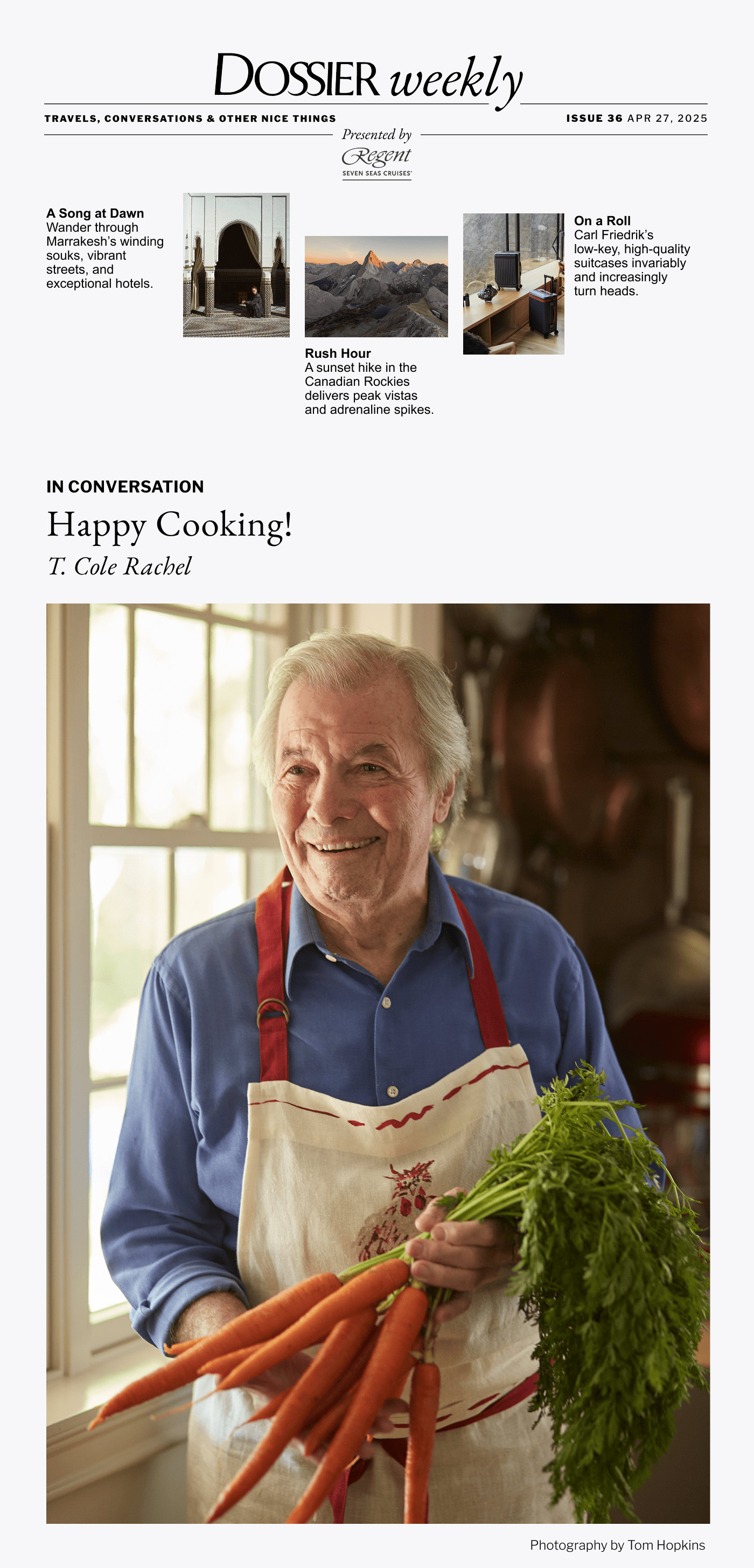
from the Dossier Weekly Newsletter, April 2025
Jacques Pépin wants you to eat well
Just shy of his 90th birthday, the beloved chef stays the course on his mission of democratizing the food industry, teaching everyone how to prepare delicious meals, and proving that healthy food need not be a luxury.
With the possible exception of Julia Child, few chefs command the same kind of universal good will – or can claim the same kind of vast influence on the world of food – as Jacques Pépin. Over the course of his career he has published over 30 cookbooks, collected 16 James Beard awards, and filmed hundreds of episodes of television shows (his PBS series with Julia Child, Julia and Jacques Cooking at Home, picked up an Emmy in 1999). He is absolutely the only person I’ve ever met who can boast not only serving as the personal chef to French President Charles de Gaulle, but can also say that he turned down the same job when it was offered by John F. Kennedy. In the world of food, there is no one more famous, revered or beloved as Jacques Pépin.
In the run up to Pépin’s 90th birthday this December, the Jacques Pépin Foundation is hosting a series of 90 dinners across the country — hosted by a who’s who of famous chefs and notable restaurants – to not only celebrate Pépin and his commitment to culinary education, but to raise funds to help further the Foundation’s mission. Dedicated to offering life skills and culinary training to individuals with high barriers to employment, as well as providing grants and educational materials to further culinary training in communities across the country, the Foundation is rooted in Pépin’s lifelong commitment to the transformative power of food. Just before I had the good fortune to share a celebratory meal with Pépin and his family at NYC’s Gramercy Tavern — an event hosted by Danny Meyer and Chef Michael Anthony to kick off the 90th birthday festivities — I had a moment to sit down with the venerable chef and Rollie Wesen, Executive Director of the Jacques Pépin Foundation, to talk about travel, education, and of course – good food.
T. Cole Rachel: Having worked around the culture of food for so long, it must be wild to see how radically that world has changed — even within the last decade — in terms of how chefs are elevated and our literacy around cooking and food.
Jacques Pépin: There is no question about it. But if you live with it as I live with it, then you don't realize the change as much, of course. But yes, back when I was chef to the president in France between '56, '58, no once did anyone call you to the dining room to say thank you or hello. Are you kidding? The cook was in the kitchen. I had never had one interview in France. Television barely existed at that point. The cook was really very low on the social scale.
And that's one of the reasons why I came to America where I worked at the Pavilion, a great restaurant. In 1960 I was up for the job at the White House, but eventually I went to work for Howard Johnson instead. People always ask me how I could have made that choice, but you have to look at it in the context of the time. I had been in New York a year or so, I was studying at Columbia. I had friends in New York. I didn’t want to charge everything again. But I didn't really think of the potential of the White House because of the experience I’d had in France. You are just in the kitchen. This is it. So you have to look at it in that context to understand. It didn’t sound all that glamorous or amazing. It would just be a different kitchen.
Frankly, I went to work for Howard Johnson because of Pierre Franey, the executive chef at Le Pavillon. Howard Johnson was a regular customer at the Pavillon. He hired Pierre. Working for Howard Johnson – imagining those restaurants – it was a different world. Later, as a professionally trained French chef, when I left Howard Johnsons after 10 years, I opened La Potagerie on Fifth Avenue. I was a consultant for the Russian Tea Room. Then I opened the World Trade Center with Joe Baum. We served between 30 and 40,000 meals a day that I set up from the commissary. I'm saying that because I would never have been able to do any of those jobs without the training of Howard Johnson. I would have never worked with chemists and with mass production stuff. I didn't know anything about any of that. So I learned a great deal at Howard Johnson. When I went there, I didn't even think of that, but that's what life is all about. You make those decisions, you don’t always know where it will lead.
T. Cole Rachel: I was thinking today about just the evolution of the American perception of fine dining. I grew up on a farm in Oklahoma in the 1980s. The only cooking shows I ever saw were mostly on PBS. So I would often see your show. I would see Julia Child. It was before the Food Network existed, before the democratization of food culture being everywhere.
Rollie Wesen: I think that was really the beauty of Julia Child. When she was on television doing The French Chef, prior to that, we had this idea of continental cuisine, and we had this idea of the really stuffy and powerful maitre d'. So when people thought of French cuisine, that's what they thought of. And it was very prohibitive. It was class prohibitive. It was cost prohibitive. It was language prohibitive because the menus were written in French. If you didn't know French, you couldn't read the menu. There were all kinds of ways to exclude you from that, right?
And then here comes Julia, and she was just fearless and courageous and didn't care if you made a mistake and said, "If you make a mistake. Don't worry about it. No one's going to see it. Just go for it. You can do it." She really implanted and imprinted that concept of, "You are capable. We can do this together. We are going to do this." And at the same time, there was Craig Claiborne, the American restaurant critic, going to Le Pavillon and the other restaurants in New York saying, "We have great restaurants. It doesn't have to be French. It's often French, but it doesn't have to be." And I think the confluence of that, and then Jacques coming on the scene, really changed a lot of people’s thinking around fine dining.
Jacques Pépin: Craig created the vocabulary of food criticism while at The New York Times. I knew Craig Claiborne from The New York Times. He did a piece on Le Pavillon. And he introduced me to Helen McCully. Helen McCully was the food editor of McCall's and House Beautiful. She kind of became my surrogate mother, "Don't do that, do this, do that." So she introduced me to James Beard because she spoke to James Beard almost every day. At some point Helen told me, "Oh, I have you heard about that woman who wrote a book on French food? She sent me the manuscript. You want to take a look at it?" She said, "She lives in Boston. She's going to come to New York. You want to cook with her?" I recall she also said, "She’s a tall woman with a terrible voice." Of course, that was Julia. So I knew Julia Child and Craig Claiborne a year after I was here. The food world was really, really small. There was no great American chef at that time. All the chefs that I knew in New York were either Swiss, French, or Italian. So yes, it's a totally different world now than it was then.
T. Cole Rachel: There's the expectation now for chefs or food celebrities that should not only be able to cook, but they should also be good on camera, writing books, creating branded products, doing social media, etc. It’s often about so much more than simply cooking. As your own career grew and you became a person who was often on television and in the public eye, was that a hard thing to become accustomed to?
Jacques Pépin: No, it was never hard for me, really I never looked at it being in the public eye, because I stayed focused on the cooking itself, and I feel very comfortable doing the cooking. So I never look further than that. I always just tried to focus on that. Doing cookbooks was harder, and I have done many. I remember when we did The Art of Cooking back in the mid 80s. There was something like 3,000 pictures. It took five years. We broke it down into two volumes with around 1,500 pictures in each. That was very complicated. All of that is very different to what I do these days, like on Facebook for example. At the beginning of the pandemic someone said, "Why don't you do small things, three, four minutes, to show people something simple?" And we have 1.9 million people now on Facebook following along. So it's a different type of cooking, but still…just cooking.
Also, the fact is that I'm older now, my metabolism changed, your idea of cooking changes. You don't put as many embellishments on the plate anymore. Now I’d rather take things away. So yes, things have certainly changed since I've been here. I have changed along the way. Now to define the whole thing, to try and break it all down, I don't think it's possible for me. You are taken by life and you move forward. I don't even realize how much I’ve done until somebody says, "I remember it was 30 years ago when you did that." I’m often surprised.
Rollie Wesen: I think the question that you ask is very interesting, though. I teach at Johnson & Wales, and so I'm often helping students to understand what the arc of their career might be. And one of the things I often stress to them is that when you think of yourself now as like, "Oh, I started out as a dishwasher prep cook," but you think your goal is to be Bobby Flay, right? What the students often don't understand is that there's really five career changes that happen along that arc, right? First, you're a cook, then you become a very good cook, then you become a middle manager, then you become a higher level manager. Then you have to learn the business, and then you have to be able to control your brand, and then maybe you have to be good on television in addition to all the other stuff. And it's really just a very elite group that actually puts all of that together and makes it happen, and most of those people have put in many many years before that happens.
Jacques Pépin: Another difference I think about is between what I may call the skillet chef and the pencil chef. You have great chefs who are working in restaurants who really want to be in the kitchen all the time, that would be a skillet chef guy. That's what he does, but if you are going to run the kitchen at a big hotel like this, you're going to have a pencil chef, a guy who can run two dinners for up to 500 to 1,000 people. It's a different type of work, and it depends on your character and what you like to do and so forth. But ultimately, no matter what, a chef has to give a lot of themselves if they want to succeed. Chefs are very generous this way. I mean, I don't really know of any great chef throughout all of my life who is not a generous person.
Rollie Wesen: Great chefs always say yes. And Jacques, I would say a big part of how you built your career through the '80s and into the '90s was that you said yes to everything. Whether it was the March of Dimes or breast cancer research or the United Way or whoever it was that came asking, you would say yes, and you would go and participate in the event. And long before there was social media, long before there was this big media construction where you would build your brand, that's how you were building your brand — you were meeting all these people, doing big events, and then you were cooking at those little cooking schools around the country.
Jacques Pépin: Back in the ‘50s and '60s, there was none of that. All through the '60 we did hundreds of dinners, including parties with Craig Claiborne in East Hampton, inviting lots of people. That's what we did for fun. I got married there and I did the food for my own wedding. I was cooking maybe an hour and a half before the ceremony. They said, "You need to get changed. You're going to get married!" There were like around 15 other chefs in the kitchen cooking with me on my wedding day.
Rollie Wesen: It’s worth mentioning that hospitality and the food world is still the land of opportunity. When we look at it from the perspective of what we're doing with the Jacques Pepin Foundation, first, we recognize there are literally one million vacancies in hospitality in the United States right now, a million open jobs, and there are thousands of people who want to work that just don't have skills to get into the workforce. So this is a very simple equation. We're going to help you learn the fundamental skills that you need, and you're going to be able to get a job. After that, how long your arc is or what kind of an arc you want to create for yourself in your career is open to you. How hard you want to work with your talent dictates what opportunities open up in front of you. But to get started, it doesn't take that much. It just takes some commitment, curiosity to learn, and a willingness to work hard.
Jacques Pépin: And it's very gratifying. Say that you have someone coming out of jail who maybe feels that they have no options. We can teach someone in six weeks. I can see that person working in the kitchen within six weeks. They can know how to peel potatoes, to poach an egg, to clean this, to operate that. In six weeks, you take your spot and if you like it, you stay there. Five years later, you're the chef there, and then you've redone your life in a sense. So it's commitment. You have to work hard but if you love it, you can always keep moving up.
Rollie Wesen: Literally from zero skill to entry level in a very short amount of time. This is something we want to make accessible to as many people as possible.
T. Cole Rachel: Considering how crazy the world has been in the past decade, and just how much culture has changed, not to mention the way that supply chains and the way people eat, the way people buy groceries, have changed so much – how has the work of the Foundation changed as a result?
Jacques Pépin: It's interesting because people are perhaps cooking less than they ever have and also more than ever before. Both things feel true. So it depends. I saw a lot of people get back to cooking for themselves during the pandemic, but on the other hand supermarkets are filled with even more pre-made sandwiches and prepared foods than ever before, which make it easy not to really cook. Recently in a restaurant a woman said to me, “We’ve decided that rain or shine, no matter what else is going on, every Wednesday night we’re going to cook at home for our kids.” I said, “That’s a great commitment, but what about the other days of the week?”
Two or three generations ago everyone learned to cook for their family from their actual family. That’s how it was with my mom. Some cooks were perhaps better than others, but that was sort of just how things worked. And then we seemed to skip a generation where some people didn’t cook at all, and then you see people now trying to grow all of their own food. It’s interesting….and also kind of amazing how little people really know about food.
Rollie Wesen: I would say, from the foundation's point of view, we teach and inspire people to cook. That's really the beginning of where we're at. And we value learning how to cook in a variety of different ways. It helps you grow personally. It helps you improve your health. It helps you save money at home, and it can help you get a job if you're looking for that skill set and you love being in the kitchen.
From the perspective of the foundation, we've leveraged off of everything that Jacques's done in his life because he loves food and he loves cooking and he loves teaching, plus he's taught in so many different ways. He taught in these little cooking schools all over the country when he was on the road 45 weeks out of the year. He's done hundreds of hours of television. He's still doing television with the Cooking At Home, but all of it is about teaching and inspiring people to cook.
I’m really interested in what he was just saying about the inequity of our understanding about food, the concept of food literacy is bothering me more and more all the time because, like you said, people are not learning how to cook in school because we don't teach home economics and they're not learning how to cook at home because their parents don't know how to cook. So we're like a half a generation away from completely losing our basic understanding of how to cook.
Jacques Pépin: And, on the other hand, there has never been as many great restaurants in America or any part of the world as there are now. So you have those two things happening simultaneously, which is interesting.
T. Cole Rachel: I was just back in rural Oklahoma in the country where my family lives and I often go to the grocery store there just to see what they have, it’s kind of an interesting litmus test. I live in New York City, so I’m spoiled here because we have access to everything, but I’ve been impressed by how the quality and variety of food even in our tiny small town grocery store in Oklahoma has changed in recent years.
Rollie Wesen: They have sriracha!
Jacques Pépin: When I came to America, I remember at 50th Street, on First Avenue, a big supermarket opened. There'd never been a supermarket, so it was a great idea. Before then I would have my fish guy, the vegetable place, you had to go to all of these different places to get what you need, but with this new supermarket everything wasunder the same roof. Everything was packaging, packaging, packaging. Great meat, including lobster meat, which for me, as a French guy, that was really fancy. But there was one lettuce called iceberg. That's it. There was no leek, no shallot, no variety of vegetables. Sometimes there was parsley, very often not, but basil? Forget it. So to go to a supermarket now? I mean, it's another world compared to what it was 50, 60 years ago.
Rollie Wesen: And at the same time, though, I think that the industrial food system has led to a kind of blandification of the food. So we see that we have more variety in the grocery store, but just this last June when I was eating these delicious strawberries from a local farm, I was pondering the question of how many people have never had a strawberry that wasn't produced by mass factory farming. It's not the same. So I think we're losing some of our taste at the same time that we are theoretically gaining variety. Like, we have more things available to us, but are they the right things?
T. Cole Rachel: And are we doing the right things with them?
Rollie Wesen: Right. Are we fostering a local short chain of commerce that's bringing the right product to the market? The thing that struck me about France the first time I was there was that you would have the most beautiful strawberries or the most beautiful apricots, the most beautiful plums, most beautiful peaches, and it would last for three weeks. And then, for the other 49 weeks, you just wait until they're back in season. Now we want to have pineapples and avocados and mangoes and strawberries all year round, but they don't taste like anything.
T. Cole Rachel: We grew all our own vegetables when I was growing up, and then we canned things. So in the months when you didn't have the garden, you had canned things from the garden.
Jacques Pépin: We did that in France too. My mother made a lot of canned stuff in jars that she put away. Think teaching kids in a family how to cook, that's what's important. I remember coming out of school, going home, and running directly into the kitchen and the smell of the kitchen, the taste of the kitchen, the voice of your father, your mother, the cooking and the cleaning up. That stays with you the rest of your life. It's really a big part of growing up. And those memories of food transcend almost everything else. What does the young soldier think of at night when he’s far away from home? He thinks of his mother, grandfather, his father, he thinks about food, of shared meals. Food really becomes love. It becomes security. Our childhood memories are almost always connected to our memories of food and family. So when you lose that, or if you never have it, you lose out on this very important part of life. For me, all good things in life connect to the sharing of good food.