My Life in Books - Kim Gordon
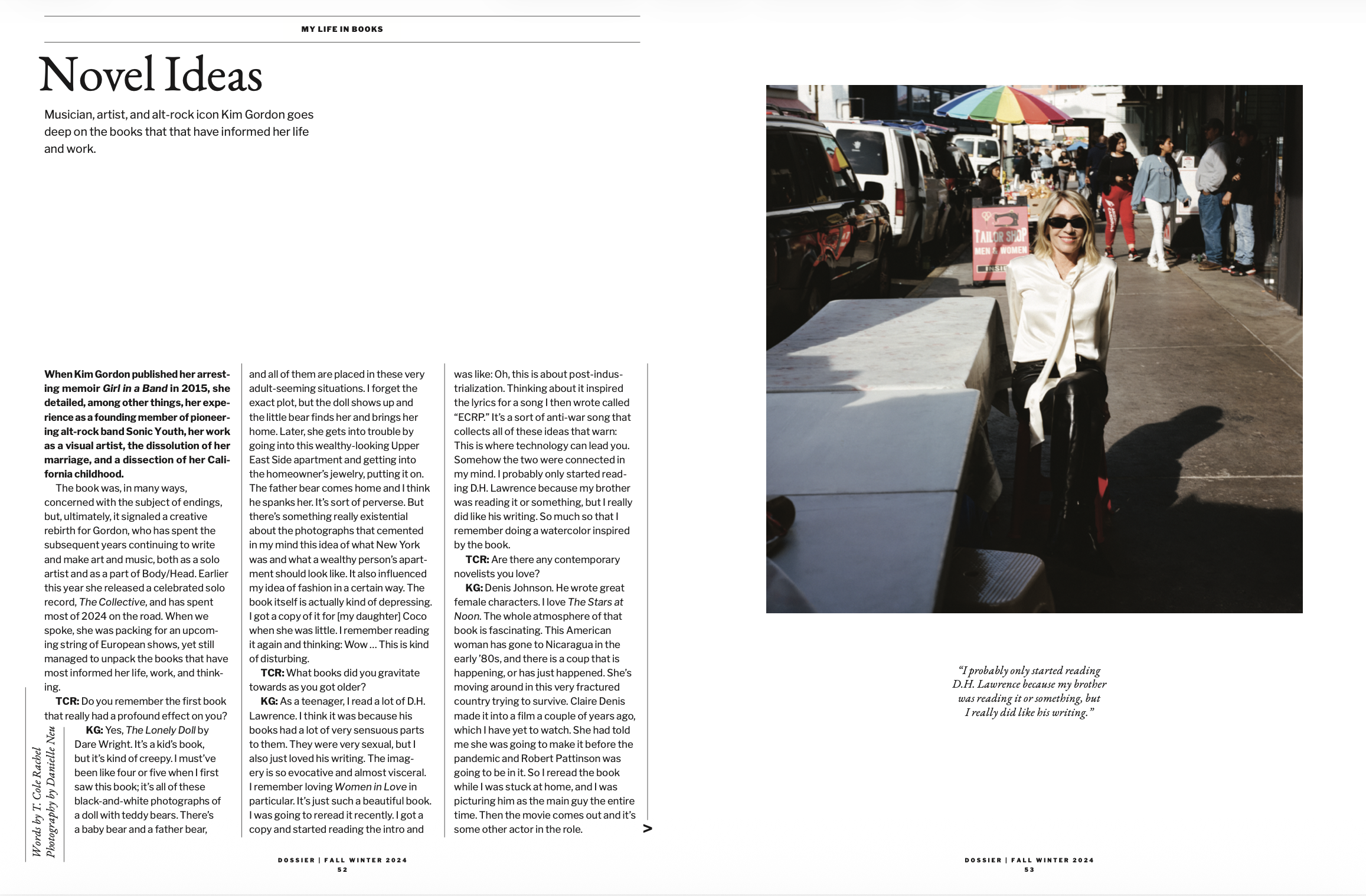
from the 2024 Fall/Winter issue of Dossier
Novel Ideas
Musician, artist, and alt-rock icon Kim Gordon goes deep on the books that have informed her life and work.
When Kim Gordon published her arresting memoir Girl in a Band in 2015, she detailed, among other things, her experience as a founding member of pioneering alt-rock band Sonic Youth, her work as a visual artist, the dissolution of her marriage, and a dissection of her California childhood. The book was, in many ways, concerned with the subject of endings, but, ultimately, it signaled a creative rebirth for Gordon, who has spent the subsequent years continuing to write and make art and music, both as a solo artist and as a part of Body/Head. Earlier this year she released a celebrated solo record, The Collective, and has spent most of 2024 on the road. When we spoke, she was packing for an upcoming string of European shows, yet still managed to unpack the books that have most informed her life, work, and thinking.
TCR: Do you remember the first book that really had a profound effect on you?
KG: Yes, The Lonely Doll by Dare Wright. It's a kid's book, but it's kind of creepy. I must've been like four or five when I first saw this book; it's all of these black-and-white photographs of a doll with teddy bears. There’s a baby bear and a father bear, and all of them are placed in these very adult-seeming situations. I forget the exact plot, but the doll shows up and the little bear finds her and brings her home. Later, she gets into trouble by going into this wealthy-looking Upper East Side apartment and getting into the homeowner's jewelry, putting it on. The father bear comes home and I think he spanks her. It’s sort of perverse. But there's something really existential about the photographs that cemented in my mind this idea of what New York was and what a wealthy person's apartment should look like. It also influenced my idea of fashion in a certain way. The book itself is actually kind of depressing. I got a copy of it for [my daughter] Coco when she was little. I remember reading it again and thinking: Wow … This is kind of disturbing.
TCR: What books did you gravitate towards as you got older?
KG: As a teenager, I read a lot of D.H. Lawrence. I think it was because his books had a lot of very sensuous parts to them. They were very sexual, but I also just loved his writing. The imagery is so evocative and almost visceral. I remember loving Women in Love in particular. It’s just such a beautiful book. I was going to reread it recently. I got a copy and started reading the intro and was like: Oh, this is about post-industrialization. Thinking about it inspired the lyrics for a song I then wrote called “ECRP.” It’s a sort of anti-war song that collects all of these ideas that warn: This is where technology can lead you. Somehow the two were connected in my mind. I probably only started reading D.H. Lawrence because my brother was reading it or something, but I really did like his writing. So much so that I remember doing a watercolor inspired by the book.
TCR: Are there any contemporary novelists you love?
KG: Denis Johnson. He wrote great female characters. I love The Stars at Noon. The whole atmosphere of that book is fascinating. This American woman has gone to Nicaragua in the early ’80s, and there is a coup that is happening, or has just happened. She’s moving around in this very fractured country trying to survive. Claire Denis made it into a film a couple of years ago, which I have yet to watch. She had told me she was going to make it before the pandemic and Robert Pattinson was going to be in it. So I reread the book while I was stuck at home, and I was picturing him as the main guy the entire time. Then the movie comes out and it’s some other actor in the role.
I just loved that book because it felt very real in the sense that it was really about [the woman’s] own crisis and identity. And even though you are getting this sense of her interior life, you still don’t totally know what’s going on with her. Is she really a reporter? Why has she really gone to Nicaragua? Anyway, I love a lot of Denis Johnson’s books. Angels is also amazing. And Fiskadoro, which has a similar atmospheric quality.
TCR: Given your California roots, it only makes sense that we’d talk about Joan Didion. If you grew up on the West Coast, there’s no escaping her.
KG: It's true. I love so much of her writing, so it’s hard to really pick just one book specifically. After I put out my memoir, I was doing an interview and the journalist asked me if I read Joan Didion. I said, not really, that she was kind of on my list, but I never got around to it. And she was like, ‘Oh, you should, because your writing and art remind me of her.’ So I started reading The White Album and then Slouching Towards Bethlehem. I loved Play It as It Lays and A Book of Common Prayer. I just really love the way she writes and, it’s true, it connects to some common California fascination for me. My mother’s family goes way back in California. They were gold rushers who came to the Sacramento Valley.
Her book Where I Was From has this essay called “Trouble in Lakewood” about this very middle-class, manufactured suburbia that was built in the ’50s for Vets and their families and to support the burgeoning Douglas Aircraft plant. The piece follows the evolution of the development through the years. By the ’80s, it had completely deteriorated and eventually became emblematic of the emptiness of this fake, middle-class life they had tried to create. As industry left the area, everything fell apart, many of the local boys turned into bullies and rapists; the value of everything there went down. I’m kind of obsessed with real estate, so that was particularly interesting to me.
TCR: Didion writes very critically about California but, for a lot of people, even her often-withering depictions remain a romantic idea of what California is really all about.
KG: Yeah. Even as she takes it all apart, you still want to go there. I totally agree. I’ve always thought that LA had this very dark underside, but that didn’t dissuade me. I read a biography of Didion recently — The Last Love Song: A Biography of Joan Didion by Tracy Daugherty — that was really good, mostly because it also had a lot of her writing in it. Sometimes I feel like biographies don’t end up telling you much about the actual person, but this one felt different. There were all these passages she wrote about driving down the highway to Palos Verdes and it being this beautiful place — not like now, where it’s just some wealthy community sliding into the ocean.

TCR: I asked Bret Easton Ellis about his favorite books set in LA. How do you feel about his work?
KG: I really loved his last book, The Shards. A big part of it was that it made me nostalgic for the areas in LA where I grew up. You know, Westwood Village, going to the Hamburger Hamlets. I love that he talks about how one of his favorite movies was American Gigolo and how it inspired him when he was in high school. I recently rewatched it and was amazed to see that it also takes place in Westwood Village.
TCR: For so many years people really associated you — both culturally and aesthetically – with New York. Are you surprised that you ended up living back on the West Coast?
KG: I never thought about it too much until it happened, but I always felt like I carried it around with me. I always felt so out of place in New York, especially when I first moved there. I was just like: ‘Oh my God, I just look so Californian and middle class. I tried to make myself look more punk. I remember the composer Rhys Chatham once said to me, “Kim, you're always going to look middle class.”
TCR: Last but not least on your list of books was Pattern Recognition by William Gibson.
KG: This was the first William Gibson book that wasn’t really science fiction, or some kind of cyberpunk story. Again, I loved this book because the female character is so good, so interesting. It’s also about the idea of someone being a kind of “cool hunter” in the culture, trend hunting for corporations. It was a pretty novel idea at the time. I’m also very into crime-noir stuff, so I liked it a lot for that reason. Also, the Sonic Youth song, “Pattern Recognition” was inspired by it.
TCR: Next year will be the tenth anniversary of Girl in a Band. Did the experience of writing that book have any affect on you as a reader — or change the way you think about other people’s memoirs?
KG: To be honest, I don't really read that many memoirs. And now there are so many. But they are going to reissue [Girl in a Band] next year, and I think I’m going to write a new chapter to add to it. I also did this small art book, Keller, about my brother who died a few years ago. Even though it was a sad subject, I really enjoyed writing again. I guess that’s what I learned from doing the book: Not just that I could write in this way, but that I also enjoyed it.
Words by T. Cole Rachel