My Life in Books - Arooj Aftab
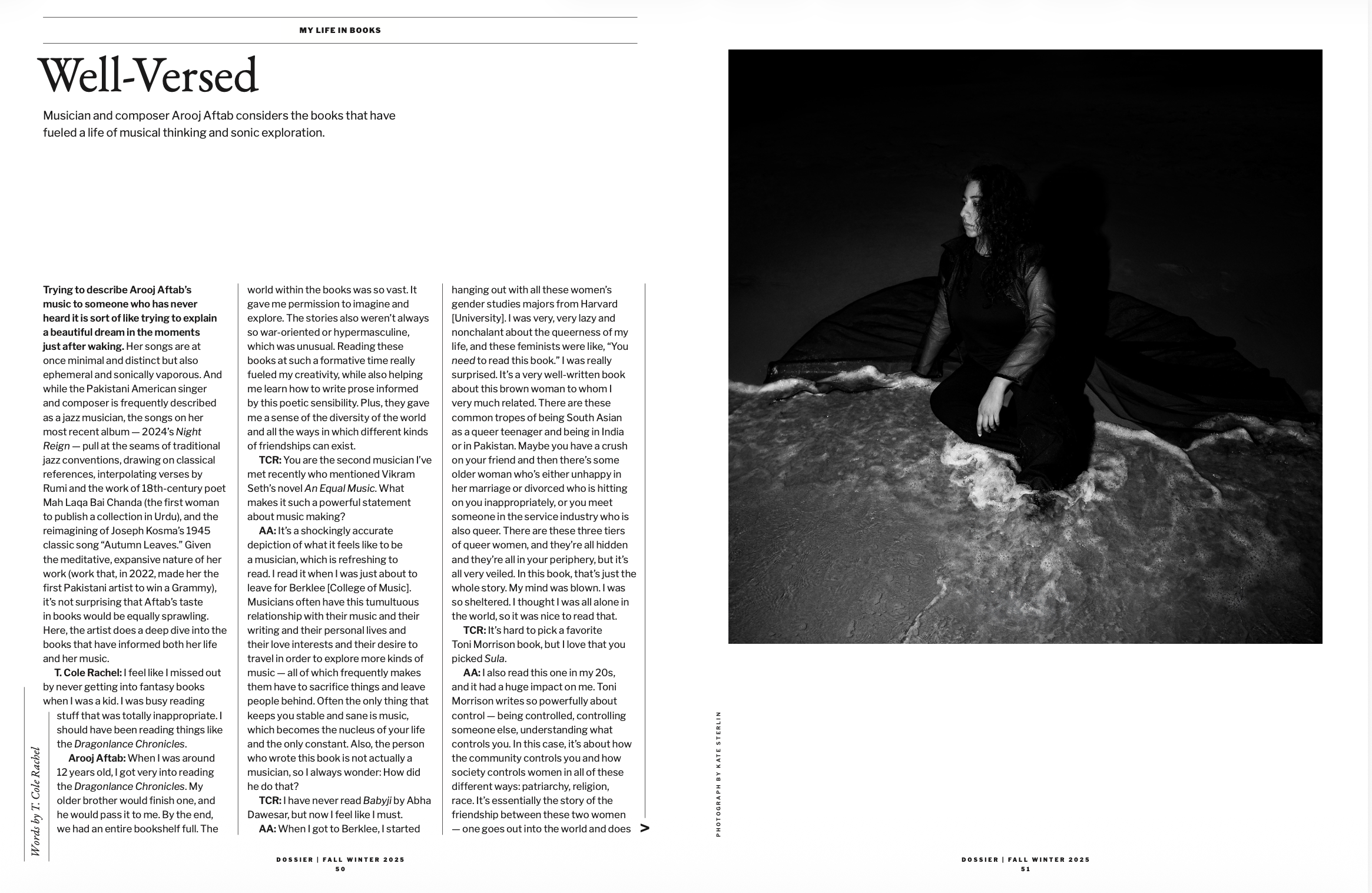
from the 2025 Fall/Winter issue of Dossier
Well-Versed
Musician and composer Arooj Aftab considers the books that have fueled a life of musical thinking and sonic exploration.
Trying to describe Arooj Aftab’s music to someone who has never heard it is sort of like trying to explain a beautiful dream in the moments just after waking. Her songs are at once minimal and distinct but also ephemeral and sonically vaporous. And while the Pakistani American singer and composer is frequently described as a jazz musician, the songs on her most recent album — 2024’s Night Reign — pull at the seams of traditional jazz conventions, drawing on classical references, interpolating verses by Rumi and the work of 18th-century poet Mah Laqa Bai Chanda (the first woman to publish a collection in Urdu), and the reimagining of Joseph Kosma’s 1945 classic song “Autumn Leaves.” Given the meditative, expansive nature of her work (work that, in 2022, made her the first Pakistani artist to win a Grammy), it’s not surprising that Aftab’s taste in books would be equally sprawling. Here, the artist does a deep dive into the books that have informed both her life and her music.
T. Cole Rachel: I feel like I missed out by never getting into fantasy books when I was a kid. I was busy reading stuff that was totally inappropriate. I should have been reading things like the Dragonlance Chronicles.
Arooj Aftab: When I was around 12 years old, I got very into reading the Dragonlance Chronicles. My older brother would finish one, and he would pass it to me. By the end, we had an entire bookshelf full. The world within the books was so vast. It gave me permission to imagine and explore. The stories also weren’t always so war-oriented or hypermasculine, which was unusual. Reading these books at such a formative time really fueled my creativity, while also helping me learn how to write prose informed by this poetic sensibility. Plus, they gave me a sense of the diversity of the world and all the ways in which different kinds of friendships can exist.
TCR: You are the second musician I’ve met recently who mentioned Vikram Seth’s novel An Equal Music. What makes it such a powerful statement about music making?
AA: It’s a shockingly accurate depiction of what it feels like to be a musician, which is refreshing to read. I read it when I was just about to leave for Berklee [College of Music]. Musicians often have this tumultuous relationship with their music and their writing and their personal lives and their love interests and their desire to travel in order to explore more kinds of music — all of which frequently makes them have to sacrifice things and leave people behind. Often the only thing that keeps you stable and sane is music, which becomes the nucleus of your life and the only constant. Also, the person who wrote this book is not actually a musician, so I always wonder: How did he do that?

TCR: I have never read Babyji by Abha Dawesar, but now I feel like I must.
AA: When I got to Berklee, I started hanging out with all these women’s gender studies majors from Harvard. I was very, very lazy and nonchalant about the queerness of my life, and these feminists were like, “You need to read this book.” I was really surprised. It’s a very well-written book about this brown woman to whom I very much related. There are these common tropes of being South Asian as a queer teenager and being in India or in Pakistan. Maybe you have a crush on your friend and then there’s some older woman who’s either unhappy in her marriage or divorced who is hitting on you inappropriately, or you meet someone in the service industry who is also queer. There are these three tiers of queer women, and they’re all hidden and they’re all in your periphery, but it’s all very veiled. In this book, that’s just the whole story. My mind was blown. I was so sheltered. I thought I was all alone in the world, so it was nice to read that.
TCR: It’s hard to pick a favorite Toni Morrison book, but I love that you picked Sula.
AA: I also read this one in my 20s, and it had a huge impact on me. Toni Morrison writes so powerfully about control — being controlled, controlling someone else, understanding what controls you. In this case, it’s about how the community controls you and how society controls women in all of these different ways: patriarchy, religion, race. It’s essentially the story of the friendship between these two women — one goes out into the world and does her own thing, never gets married, achieves all of the goals she has worked for. The other, who stays put, conforms to societal standards, gets married — all of the expected things. This felt so much like my life in so many ways. I was watching all of my friends get married or sort of let go of their dreams, while I was the one who was made to feel crazy for doing this thing that had no future and made no sense and was risky. When you are the one going against expectations, often you have no support. You can only depend on this insane belief in yourself.
TCR: It’s been so gratifying over the past couple of years to see so many people discover Octavia E. Butler. Her books are so amazing and so wild. Just try describing the plot of Wild Seed to someone who has never heard of it before.
AA: It’s an insane book. But like you were saying, so many people are rediscovering her work. As someone who read The Lord of the Rings and A Game of Thrones and those kinds of books, mostly by all white writers, I found reading sci-fi work by Octavia Butler so mind-blowing. She changed the whole genre. She elevated it. Her work also offers an important message. She’s giving a warning to people that if you have power, if you have a gift, if you have magical properties, people will come for them. They will be taken away or something will happen and they will get corrupted.
TCR: I love a celebrity memoir and I love Viola Davis, so Finding Me sounds like a win-win. Lots of people I know love this book.
AA: I suggest listening to it if you can. I’ve been listening to it while I’m working in the kitchen or when I’m on a plane, and her story, plus her voice, is so powerful. Listening to her talk about the entertainment industry has been really comforting, and enraging, and affirming. It feels similar to the way my life has changed in the last few years and how I’m navigating the industry, facing so many of these atrocities of being a woman and being a woman of color. There aren’t enough safe, uplifting spaces in our industries. One day you’re just this unsuccessful Indian musician making your tunes and living your life, and it’s simple. When you break past that, you’re like, “Oh, shit, it’s evil out here, and I’m in the middle of it.” So this book felt very healing.
TCR: Give My Regards to Eighth Street is a great book for anyone who doesn’t know about Morton Feldman’s music, but it’s also just a fascinating book.
AA: It really touched me to learn about the history of Brooklyn and the relationships between these (now iconic) artists back when they were busted and crashing illegally in loft spaces and warehouses in Williamsburg [a neighborhood of Brooklyn]. Feldman’s friendships with Philip Glass and [Mark] Rothko are fascinating — also, the way he describes his approach toward composition. When I was reading it, I was earmarking different passages, using it as a tool to better understand his work.
TCR: I honestly didn’t know much about Henry Threadgill until you recommended Easily Slip Into Another World.
AA: Henry Threadgill is not somebody that people are like, “Yeah, we need to make a documentary about that guy,” but he is so important and, of course, overlooked and such a powerful, key person in the history of American jazz music. I’m so glad this book exists and it’s so well-written and that we have access to another really important piece of history that involves these incredible artists, just like the Morton Feldman book. It’s a reminder that, in an artistic community, everybody’s fueling each other. Artists are not ever moving in a singular way; they are all affecting each other and informing each other’s work. I don’t really know if that’s happening right now.
TCR: As someone who has spent much of their career writing about music, I love that you included Quantum Listening by Pauline Oliveros on your list. Her take on deep listening — this larger cosmic experience of listening to music — is so incredible.
AA: The book was totally reamplifying things in a way that was organized and made sense to me. Truly deep listening. It made me think about when I first told my dad I wanted to study music. He was like, “Listen, you’re confusing yourself, a lover and listener of music, with the people who make music.” I was like, “No, I’m actually not doing that. I am both of those things and also more. I am a musician.” That was the first time that this idea, this critical investigation into the two sides of musicianship and loving music, came up for me. This book is so important. It is a highly irresponsible thing when music writers and music listeners and music makers — anyone who cares about music — has not read this book. This book is our guide.
Words by T. Cole Rachel
Photography by Kate Sterlin and Valentina von Klencke