from the 2025 Fall/Winter issue of Dossier
One Stitch at a Time
With a network of knitters spread across New York City, Hania creates luxury goods imbued with a distinctly human touch.
I spend a disproportionate amount of my time in Midtown Manhattan, but there are few places within this stretch of the city I might refer to as an oasis of calm. That being said, walking into the showroom of Hania New York — a luxury knitwear brand tucked onto the fourth floor of an unassuming building on West 56th Street — I am struck by a feeling of peace. The bright, airy space is populated with racks of beautifully rendered sweaters in mostly monochromatic hues. Tables are piled with pillowy cashmere in the form of hats, sweaters, and scarves, accompanied by the occasional bowl of fresh flowers. It is quiet, but I can hear voices and the faint click of knitting needles reverberating from a nearby room.
Hania is the longtime passion project of Anya Cole, and this space — in addition to being a showroom for buyers and private clients — is the central hub for a creative community she has helped foster for the better part of two decades. Having grown up as a trained ballet dancer in Poland during the height of the Cold War, Cole filed for refugee status in the late 1980s in order to emigrate to the United States. Arriving with only a few suitcases and her young daughter in tow, she was determined to plot her own course.
“I was a single mother, and I wanted my daughter to have a better life,” she recalls. “I eventually got a job as a fashion merchandiser because I knew how to make things look nice. Growing up behind the Iron Curtain, I could never buy anything. Someone would bring us a magazine with pictures of all of these beautiful clothes and sweaters, and I would figure out how to make my own version of them. I always just had to create. Growing up in Poland taught me how to be resourceful. You learned to take whatever you had and make it look pretty.”
Cole was determined to turn her personal creative pursuit into a business that would not only speak to her own passions but also, ultimately, benefit other women like herself. This dream led to the creation of Hania, a knitwear business that drew on her own design skills and catered to clientele looking for special, one of a kind pieces. Faced with orders from department stores that she could not fulfill on her own, Cole found an unlikely recruitment source at her own front door. “Many of the doormen in my building were Albanian,” she recalls. “Some of them had wives who were struggling to find work. Turns out, many of them knew how to knit.” This set in motion what would become the business model for how Hania still operates — employing women across the five boroughs of New York City and paying them a fair wage for their work.
What began with just a handful of knitters grew into dozens. In a position now to help other women from similar circumstances, Cole wanted to make sure knitters were paid justly, given benefits, and made to feel that they were part of a supportive community. Over the next decade, Hania would engage with over 100 freelance knitters, each working from home and taking on as much or as little work as individual schedules would allow.
“I very much relate to these women,” explains Cole. “I was that same person — a refugee, an immigrant. Many of them don’t speak English; some have full-time jobs while others are caregivers at home. This work helps subsidize their income, but it also gives them a connection to other people.”
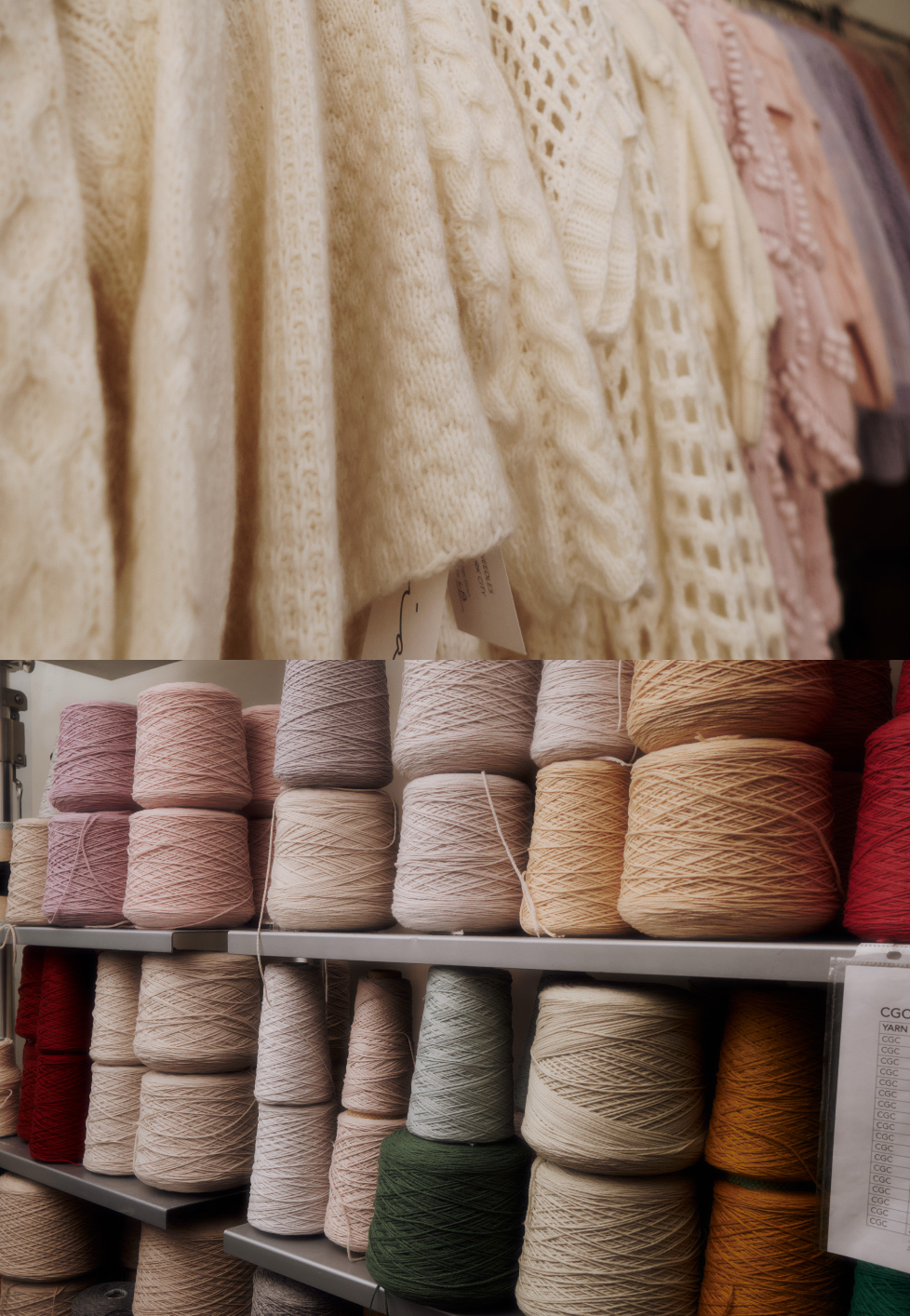
While the showroom at Hania is itself a thing of beauty, it’s the workroom that most excites me. For a novice knitter such as myself, being surrounded by some of the most luxurious yarn in the world is its own kind of thrill. For its sweaters, Hania uses only the finest ethically sourced cashmere fibers, working with the same companies that provide yarn for the world’s most exclusive luxury brands. Hania offers free repair on all of its sweaters and will launder them if a customer is wary of accidental shrinkage. Additionally, if a sweater no longer fits or a customer no longer wants to wear it, Hania will unravel it and repurpose the yarn for a new piece. Looking through bins of feather-light Mongolian cashmere, I understand the company’s ethos even more: Given the care and craft with which Hania’s garments are made — not to mention their exquisite materials — they are anything but disposable.
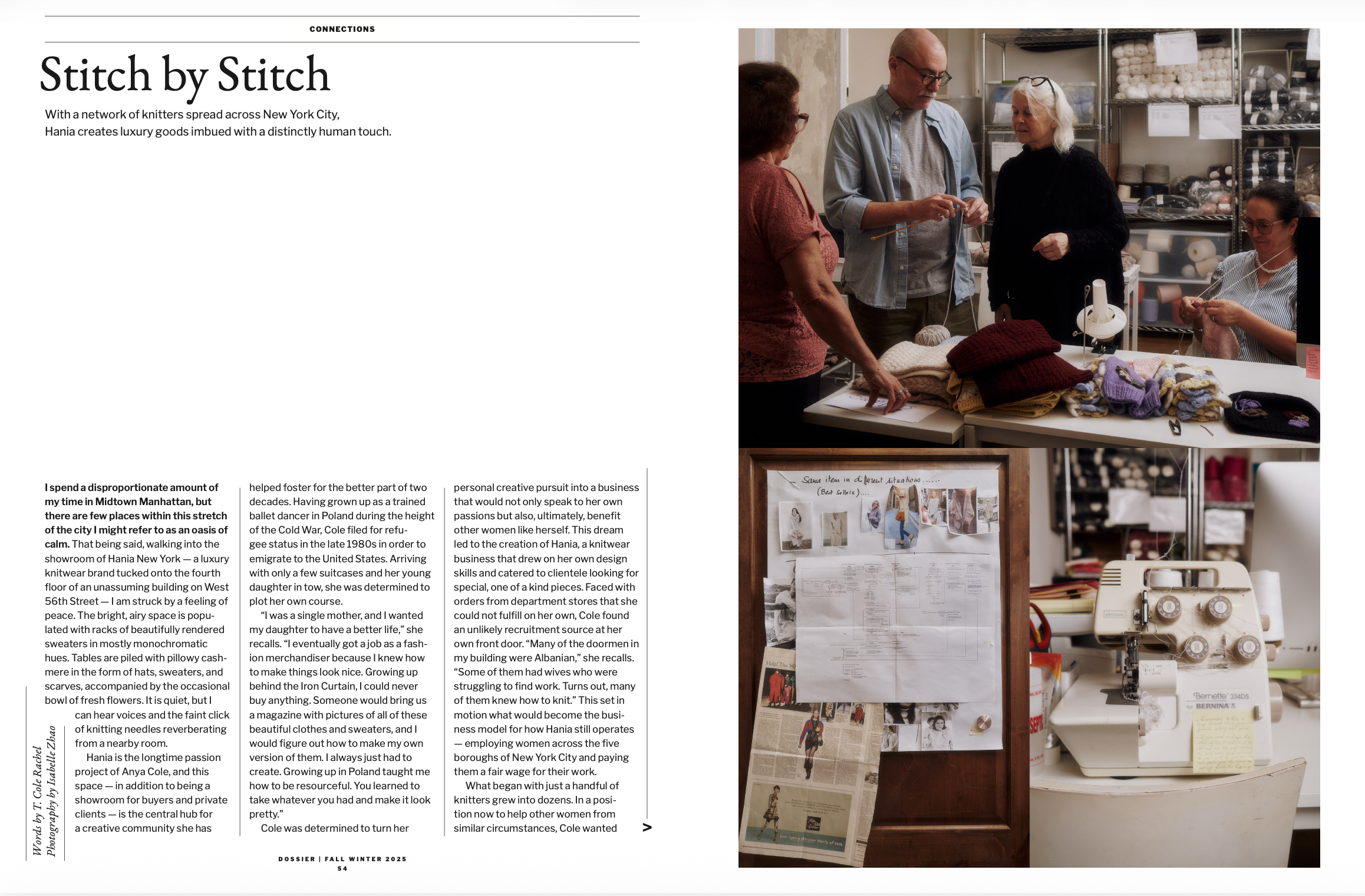
The workroom is also where knitters come to pick up or drop off orders and, depending on the day and time, to sit, socialize, and, of course, knit. On the day of my visit, Fatime Belliu, a knitter who also serves as Hania’s office manager and unofficial right hand, greets me. Originally from Kosovo, Belliu frequently serves as the conduit connecting Hania’s Midtown operation with the tight-knit community of Albanian women in the outer boroughs who take on much of the knitting. As she explains it, these women regularly meet at a park in the Bronx to sit and knit together, often sharing work or delivering pieces to and from the office for one another. The work is valuable for the money it provides, but for many in the group, the connection to community proves just as important.
“I was working as a teller at Bank of America in my neighborhood in the Bronx,” Belliu explains, “and one of our knitting ladies, she still works here, came to cash a check. I asked her where she was working, and she gave me Anya’s phone number. Lots of women I knew were looking for work, so I thought maybe I could help some of them. I started here just as a knitter, but Anya offered me a full-time job. That was over 13 years ago.”
I also meet Hindire Tetaj, another longtime Hania knitter, who is known for her advanced technique and tackling some of Hania’s more complicated designs. Tetaj comes into Manhattan in the evenings to work as a cleaner in Midtown office buildings, but her daytime hours in the Bronx are spent knitting and making jewelry. She speaks little English, so Belliu steps in to translate. When I ask if it’s hard to juggle a night job with Hania’s projects, Tetaj — who is constructing a delicate cashmere sleeve while we talk — only smiles and shakes her head.
“If you love to make things, you’ll find a way to do it — even if it’s not for work,” she says. “Making things relaxes you; it’s good for your mental health. Also, I just can’t go without knitting. If I have a spare moment, I’m knitting. I can’t go to sleep at night unless I do some knitting. Even if I didn’t need the extra money, I would still do this.”
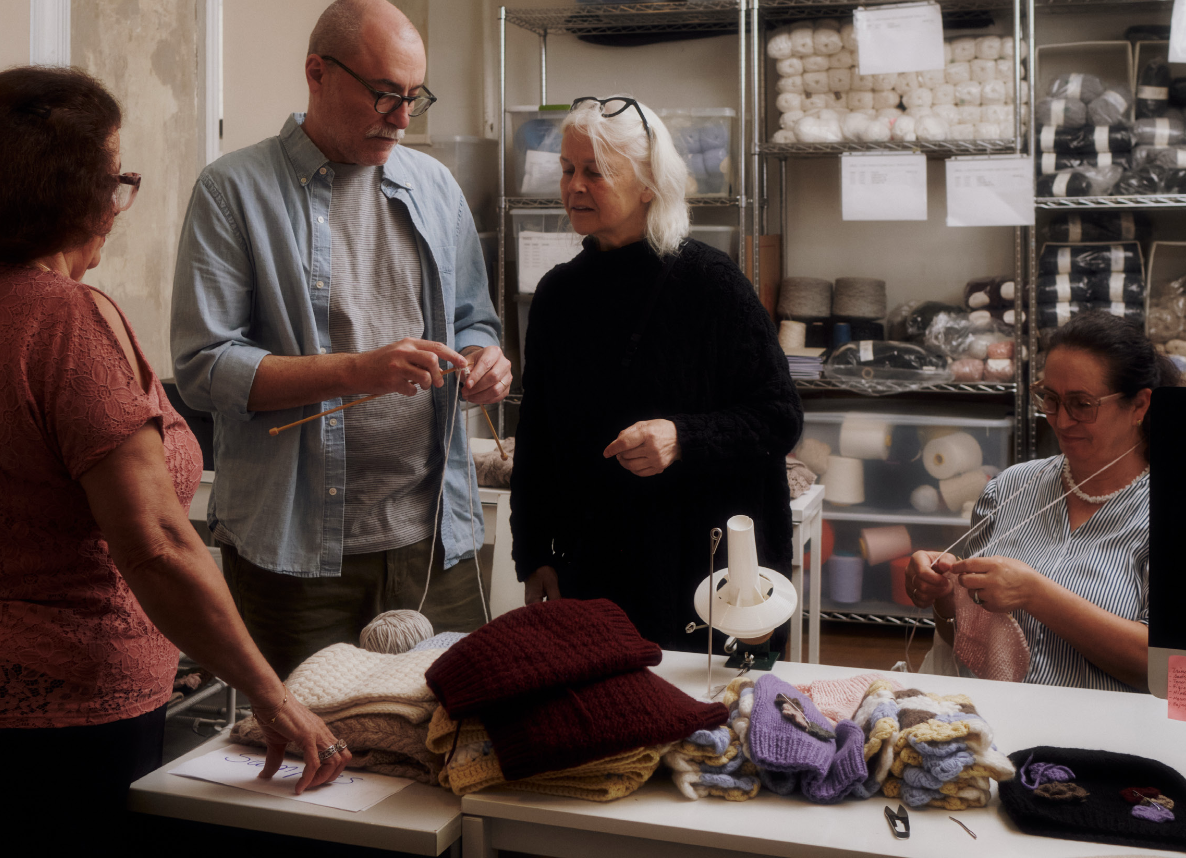
When I mention that I, too, am a knitter, albeit a fairly amateur one, Belliu immediately presents me with two bamboo knitting needles and a skein of heavy cashmere yarn. The three women gather around as Cole commands, “Okay, show us how you knit.” Under the watchful eye of these three master craftspeople, I manage to knit a few rudimentary rows. Even though my work is clumsy, everyone is exceedingly kind. “We could hire you,” laughs Belliu. “If you can do a simple knit and purl stitch, we can teach you how to make a sweater.”
Looking at all the work in progress happening around the room, Cole explains why this work and business remain joyful for her. “This is why handmade things are so wonderful,” she explains. “There is no wrong way to do it. I knit a certain way; some people do it differently. Everyone holds their needles a different way, works in a different way, at a different speed. After working together so long, I can tell who made something just by looking at the work. And when you really know someone well, you can look at the work and tell if they were happy or sad — or if maybe they were stressed or tired, just by looking at the stitches. Our hands tell the story. That’s what makes these pieces so special. It’s not just that they are beautiful; they are filled with everyone’s stories.”
Words by T. Cole Rachel
Photography by Isabelle Zhao