My Life in Books — Justin Bond
from the 2025 Spring/Summer issue of Dossier
Source Material
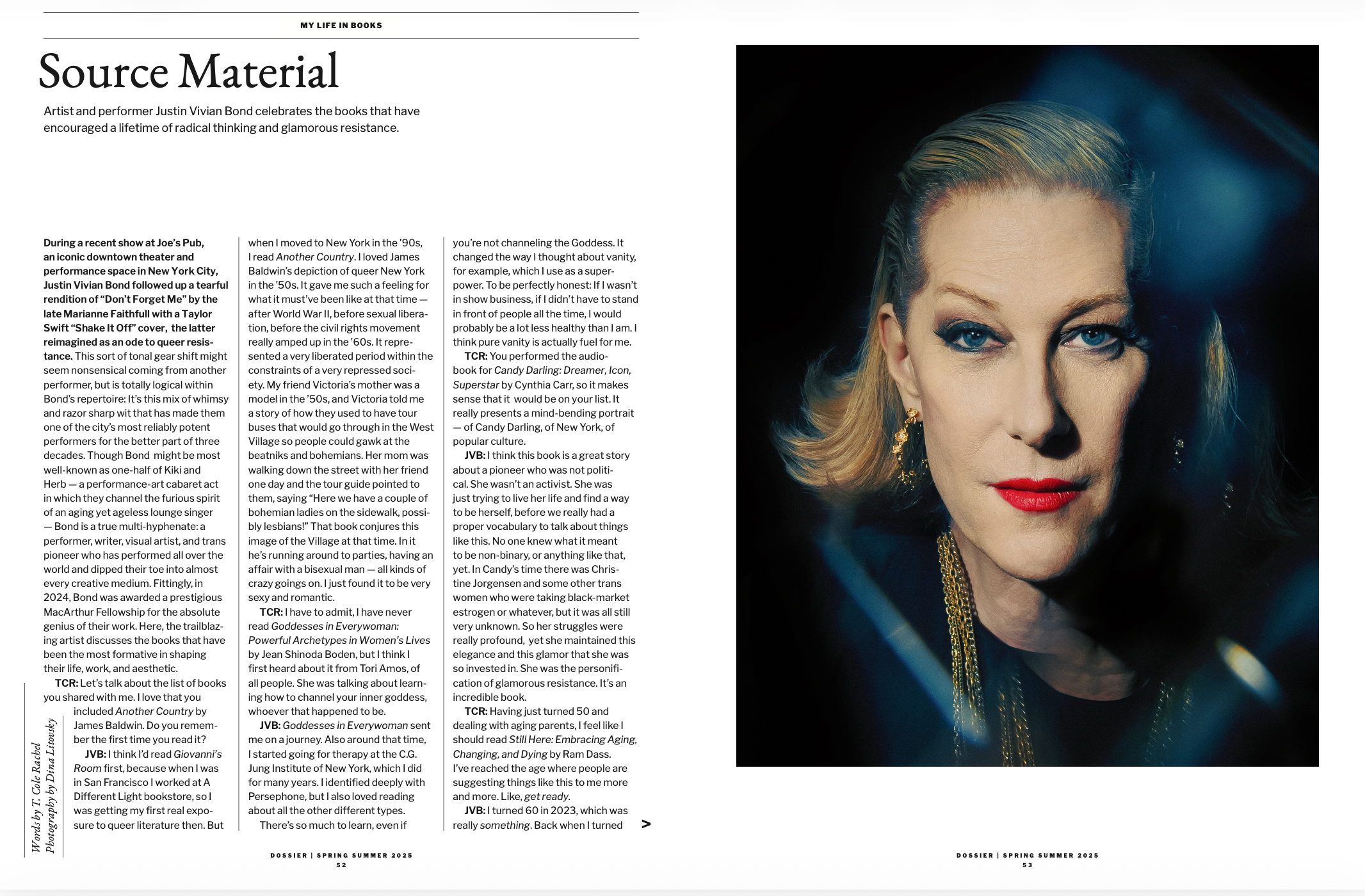
Artist and performer Justin Vivian Bond celebrates the books that have encouraged a lifetime of radical thinking and glamorous resistance.
During a recent show at Joe’s Pub, an iconic downtown theater and performance space in New York City, Justin Vivian Bond followed up a tearful rendition of “Don’t Forget Me” by the late Marianne Faithfull with a Taylor Swift “Shake It Off” cover, the latter reimagined as an ode to queer resistance. This sort of tonal gear shift might seem nonsensical coming from another performer, but is totally logical within Bond’s repertoire: It’s this mix of whimsy and razor sharp wit that has made them one of the city’s most reliably potent performers for the better part of three decades. Though Bond might be most well-known as one-half of Kiki and Herb — a performance-art cabaret act in which they channel the furious spirit of an aging yet ageless lounge singer — Bond is a true multi-hyphenate: a performer, writer, visual artist, and trans pioneer who has performed all over the world and dipped their toe into almost every creative medium. Fittingly, in 2024, Bond was awarded a prestigious MacArthur Fellowship for the absolute genius of their work. Here, the trailblazing artist discusses the books that have been the most formative in shaping their life, work, and aesthetic.
TCR: Let’s talk about the list of books you shared with me. I love that you included Another Country by James Baldwin. Do you remember the first time you read it?
JVB: I think I'd read Giovanni's Room first, because when I was in San Francisco I worked at A Different Light bookstore, so I was getting my first real exposure to queer literature then. But when I moved to New York in the ’90s, I read Another Country. I loved James Baldwin’s depiction of queer New York in the ’50s. It gave me such a feeling for what it must've been like at that time —after World War II, before sexual liberation, before the civil rights movement really amped up in the ’60s. It represented a very liberated period within the constraints of a very repressed society. My friend Victoria's mother was a model in the ’50s, and Victoria told me a story of how they used to have tour buses that would go through in the West Village so people could gawk at the beatniks and bohemians. Her mom was walking down the street with her friend one day and the tour guide pointed to them, saying “Here we have a couple of bohemian ladies on the sidewalk, possibly lesbians!” That book conjures this image of the Village at that time. In it he’s running around to parties, having an affair with a bisexual man —all kinds of crazy goings on. I just found it to be very sexy and romantic.
TCR: I have to admit, I have never read Goddesses in Everywoman: Powerful Archetypes in Women’s Lives by Jean Shinoda Boden, but I think I first heard about it from Tori Amos, of all people. She was talking about learning how to channel your inner goddess, whoever that happened to be.
JVB: Goddesses in Everywoman sent me on a journey. Also around that time, I started going for therapy at the C.G. Jung Institute of New York, which I did for many years. I identified deeply with Persephone, but I also loved reading about all the other different types.
There's so much to learn, even if you're not channeling the Goddess. It changed the way I thought about vanity, for example, which I use as a superpower. To be perfectly honest: If I wasn't in show business, if I didn't have to stand in front of people all the time, I would probably be a lot less healthy than I am. I think pure vanity is actually fuel for me.
TCR: You performed the audiobook for Candy Darling: Dreamer, Icon, Superstar by Cynthia Carr, so it makes sense that it would be on your list. It really presents a mind-bending portrait — of Candy Darling, of New York, of popular culture.
JVB: I think this book is a great story about a pioneer who was not political. She wasn't an activist. She was just trying to live her life and find a way to be herself, before we really had a proper vocabulary to talk about things like this. No one knew what it meant to be non-binary, or anything like that, yet. In Candy’s time there was Christine Jorgensen and some other trans women who were taking black-market estrogen or whatever, but it was all still very unknown. So her struggles were really profound, yet she maintained this elegance and this glamor that she was so invested in. She was the personification of glamorous resistance. It’s an incredible book.
TCR: Having just turned 50 and dealing with aging parents, I feel like I should read Still Here: Embracing Aging, Changing, and Dying by Ram Dass. I’ve reached the age where people are suggesting things like this to me more and more. Like, get ready.
JVB: I turned 60 in 2023, which was really something. Back when I turned 50, I had no problem with it. It was actually kind of a very wonderful time in my life, and I had a really celebratory journey. My 50s were the best decade of my life, hands down. But I had a little trepidation about turning 60, because that just seems like you start to understand that your days are numbered, honey. I started reading Still Here in the fall of 2022 and, shortly after, my mom was diagnosed with terminal cancer and given only a few months to live.
We found out three days before Christmas, so I went down to Maryland to take care of her. I was reading that book while she was literally in bed dying. So I'm reading the book and she's so ill and hallucinating, and we're having these wild conversations. Thank God I had that book, because it really kept me grounded and in the moment. It kept me connected to the spiritual side of what was happening so that I didn't focus on anything except for what needed to happen between the two of us — to not be in denial of it, but to be calm and present with her, and to just ease her journey. It was truly incredible how much that book applied to my situation at that time.
TCR: You are only the second person I’ve talked to for one of these “My Life in Books” pieces, yet I’m not surprised that, so far, both subjects have cited Joan Didion’s Play It As It Lays.
JVB: I first read it when I was in high school. I was kind of obsessed with the 1960s in San Francisco because of the “Free Love” and the anti-war stuff, the protesting and all that. Somehow I knew that was a key to my own personal liberation, even from a distance. So I read Play It As It Lays, and I really didn't understand it. Then I started to read it again every year. Then when I was in my junior year of college, I took a solo performance class [and] had to come up with a solo show. I was new at it and I didn't know what I was doing, so I just lifted sections from Play It As It Lays as the monologues that were the interstitial material between my songs. I was drawn to Didion’s nihilism in a certain way, but also her passion and her conflict between the past and her present, who she was and how she had to present herself. All of this was something I could relate to: having really mixed feelings about your family and where you come from and not getting what you need from them. Joan Didion represented this dry intellect that was so different from my own, but that I very much aspired to.
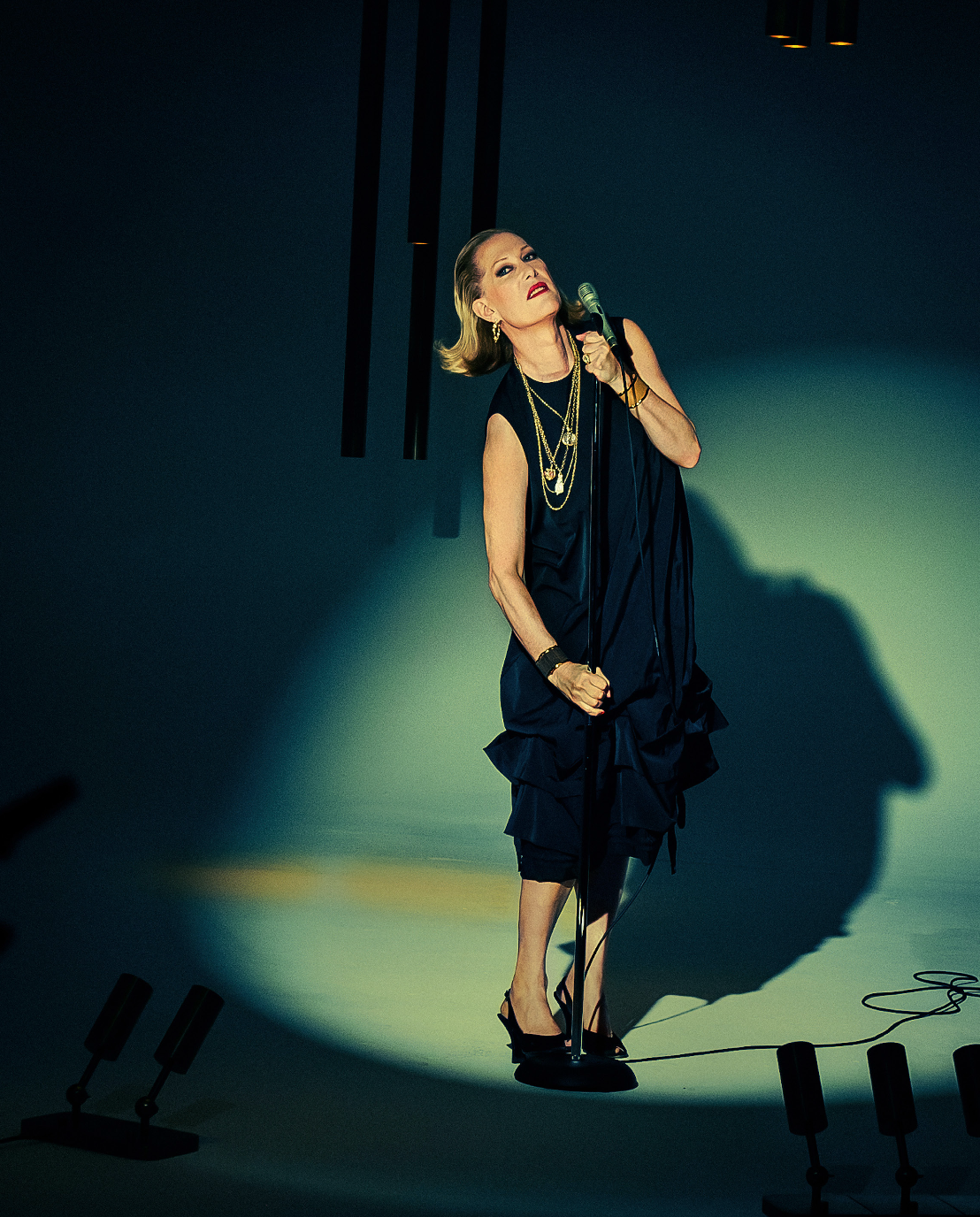
TCR: Given that you’ve worked so much in nightlife and cabaret, it makes sense that you might choose James Gavin’s Intimate Nights. This book is the blueprint.
JVB: When I was young, I saw Alberta Hunter on The Merv Griffin Show, and I became obsessed with her. I was like, ‘That's what I want to do. I want to be a cabaret singer in New York, and I want to have a residency, and I just want to play there regularly until I die,’ which is what I'll hopefully do at Joe's Pub.
I found Intimate Nights when I was working at City Lights, and it really described not only the places where cabaret took place in New York City, from the ’20s till the present day, but it also talked about the spaces, the owners, all the acts. It was really informative, because he would talk about how they built their sets, how they structured their acts, how the club owners might insist on certain types of numbers in specific order, because that is how you kept the audience's attention. It was really a masterclass in how to make a cabaret show. And that is how I learned to structure my own cabaret shows, as well as how we put together Kiki & Herb shows. Then he did a new edition of it in the early 2000s and he included us. That was really very, very special to me: To take my place within that history was really extraordinary.
TCR: I feel like people sleep on Lipstick Traces by Greil Marcus and forget how important, and how deeply formative, it was for those of us who grew up before the advent of the internet.
JVB: I know there are playlists based on Lipstick Traces, but back in 1989 you’d have to go out and find all of these things. Greil Marcus draws this amazing through line that connects history with culture — the student revolutionaries in France, the punks, Malcolm McLaren — those were all literal things he connected, but then you also hear about all of the different musical acts and singers and bands and all of that. It's not like today, where you can just go on YouTube or Google something. You couldn't do that then.
This book was so informative for those of us living through Queer Nation and Act Up, and what we were going through during the AIDS crisis in San Francisco, fighting for our lives and against the government. We had to beat down the walls and find ways to get through and have our voices be heard. To read this cultural history and to realize we were a part of that lineage of protest, that there were precedents for what we were doing and what was happening to us, it really informed me.
We didn't document Kiki & Herb very much. Kiki and Herb were meant for the audience they were performing in front of. It was made for the people who needed to see it and needed to be in that room, and also really understood where it was coming from. I learned the importance of that and the value of that and the historical context for that from Lipstick Traces. To think of my work as a part of that kind of cultural resistance? I’m very proud of that.
From Dossier Magazine
Words by T. Cole Rachel
Photography by Dina Litovsky