from the Dossier Weekly Newsletter, July 2025
Remembering Edmund White
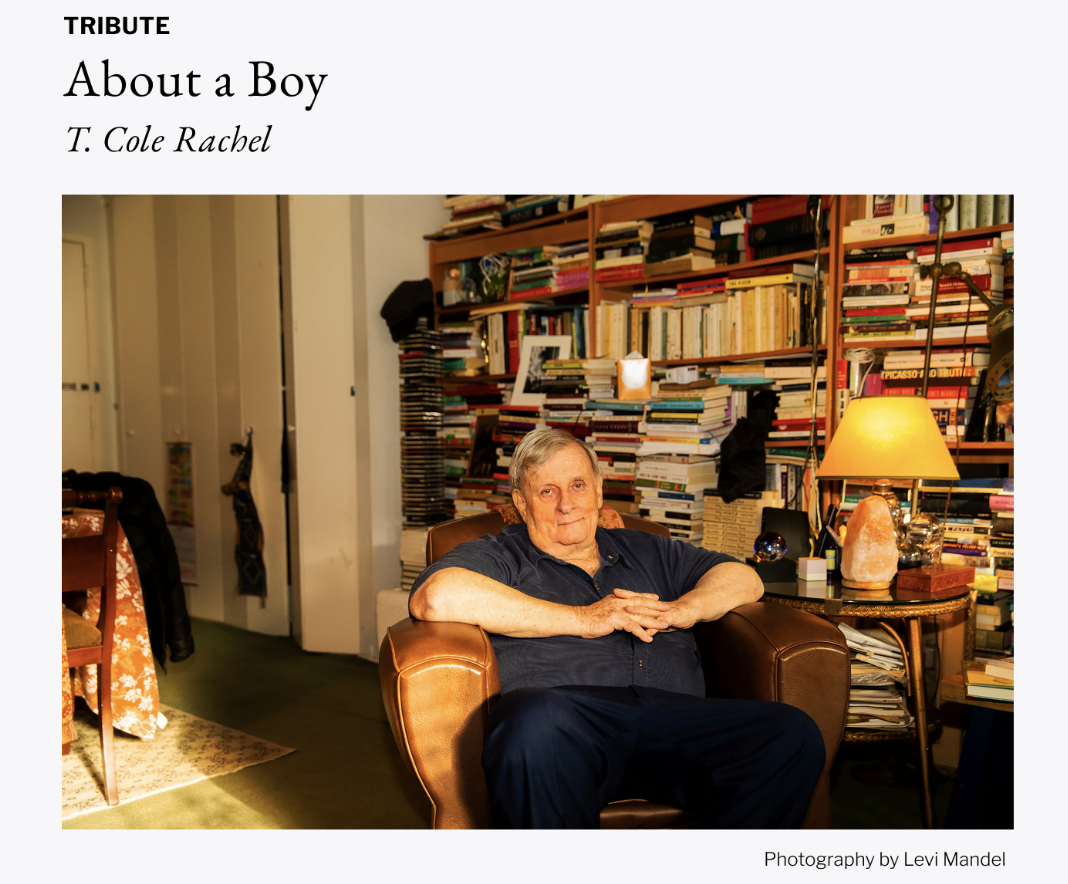
The great Edmund White has left us. As someone who had the joy of enjoying a decades long friendship with him and, like so many other writers, benefited from his kindness and support, this truly feels like an incalculable loss. While he will be rightly remembered as one of the greatest gay writers of all time — a trailblazer whose work, particularly A Boy’s Own Story, would light a path for generations of queer voices to follow — he was also much more than that. Edmund’s sprawling, genre-expansive body of work is a testament not only to his genius as a writer, but also to his voracious intellect, his curious mind, his unrivaled understanding of art and literature, and his tremendous capacity for dissecting the human condition.
In 2009 I spoke with Edmund for the previous incarnation of Dossier. Our chat precipitated the publication of City Boy, a memoir detailing his years as a struggling writer in New York City in the ‘60s and ‘70s. At the time of our conversation, I remarked that “Sitting down to talk with Edmund White is an experience not unlike reading one of his books. He is charming, funny, simultaneously erudite and salacious, and wonderfully frank. A conversation about an old poetry book suddenly becomes a kaleidoscopic view of New York’s literary milieu and then, just as quickly, a story about sex.” Revisiting this interview now, I am not just reminded of Ed’s indefatigable charm, but by the extent to which he was not only a witness to cultural history, but a remarkably active participant. I will miss him terribly. —T. Cole Rachel
There has been this trend as of late to really glamorize New York in the ‘70s, but most people will tell you that it was a much different thing to have actually lived through it.
Most of the time they are talking about the downtown music scene, which I don’t really write about at all. I was never a part of that and it didn’t really interest me. My only connection to that world was through Robert Mapplethorpe, but it wasn’t like he was taking me to clubs or anything … well, not music clubs. Sex clubs, maybe. I was much more interested in what was happening uptown during the ‘70s — you know, John Ashberry, Jasper Johns, Balanchine, Sontag, and Richard Howard.
You’ve published books of almost every possible genre — novels, memoirs, biographies, criticism, essays, plays — I’m assuming that they all come with their own specific difficulties.
They couldn’t be more different, really. I’ve written three biographies—Rimbaud, Proust, and Genet. Two of them—Proust and Rimbaud—have been so heavily written about and lived so long ago that there was really no need for primary research. The Genet biography was the first on him, so it was all primary research, plus he was an incredibly shadowy and secretive person, which made him an incredibly difficult subject. That book ended up taking about 8 or 9 years of my life. I’d never do a book like that again, but I’m certainly glad that I did it. I learned a lot about France, not to mention Genet. These other short biographies I’ve written are fun to do because the subjects have been so widely covered that you are free to make your own assertions about them. With Proust I talked about his homosexuality in a way that completely scandalized the keepers of the flame. The New York Review of books basically shat on me for talking about his sex life so much. They said I was taking away his universality by framing him so much as a homosexual. It’s a bit like saying that if you talk about Toni Morrison as a black writer that you’d be taking away her universality. I don’t think you would. It kind of shows how much contempt that gays are still held in—to talk about some famous person being gay is often still somehow demeaning.
Even after having written so many books—and so many different kinds of books—does it bother you that you register first and foremost in most people’s minds as a “gay writer?”
You know, I feel like I owe what tiny bit of celebrity I might have to that label. In other words, I hear other gay writers of my generation bitching about it, but I think ‘Come on, Mary. Would you even have a slot on the shelf at all if it weren’t for that?’ I mean, I think I’m a pretty good writer, but there are tons of good writers and many of them are less well known than I am. When I wrote A Boys Own Story the whole idea of a “coming out” novel was unheard of. It was basically the first one. I guess that’s always been a knack of mine, to get there first. (laughs) It’s probably just because I’m so old though. You can’t help but get there first when you’ve been around forever.
It’s interesting to see the ways in which gay relationships have continued to change. Your descriptions of gay relationships in the 70’s make everything sound so amorphous.
We really had a much more experimental approach to love than people do now. There really was the feeling that some people should be your friends and others your fuck buddies and others your lovers, maybe even sexless lovers. It didn’t matter. There really was this division of labor among many people. Now people want everything from just one person and they want gay marriage. The gay partner has to be this ideal person. And babies, they want those. I think that might work for a few people, but I don’t even think that works for most straight people, to be honest. I’m all for marriage in the sense that whatever straights can do, gays can do. I’m generally against marriage for my friends and I recommend that my straight friends not get married…or if they are married, I recommend that they get divorced. I don’t think it’s a good idea. I don’t think it works. But I do think that gays should have the right to make the same bad decisions as everyone else.
You’ve lived all over the world, but have always maintained a home here in New York. Why do you think you’ve always come back here?
Well, I’m basically a sex addict and New York is a good place for that. (laughs) It's a very good gay city, I think. I tried living in San Francisco but I really didn’t get it. My personality just didn’t fit there. They just found me too aggressive or something. Plus, they really believe in leisure there, which doesn’t really suit a New Yorker. Here you are required to be so disciplined and I feel like I need that. It’s funny, I feel like I have a pretty good life here and a nice apartment, but I’ve been interviewed by people here and then later will read things like, “Oh poor Mr. White has written all of these books and he still lives in a shabby little apartment.” I guess by the standards of other places it seems shabby, but by New York standards it seems really nice.