My Life in Books — Lucy Dacus
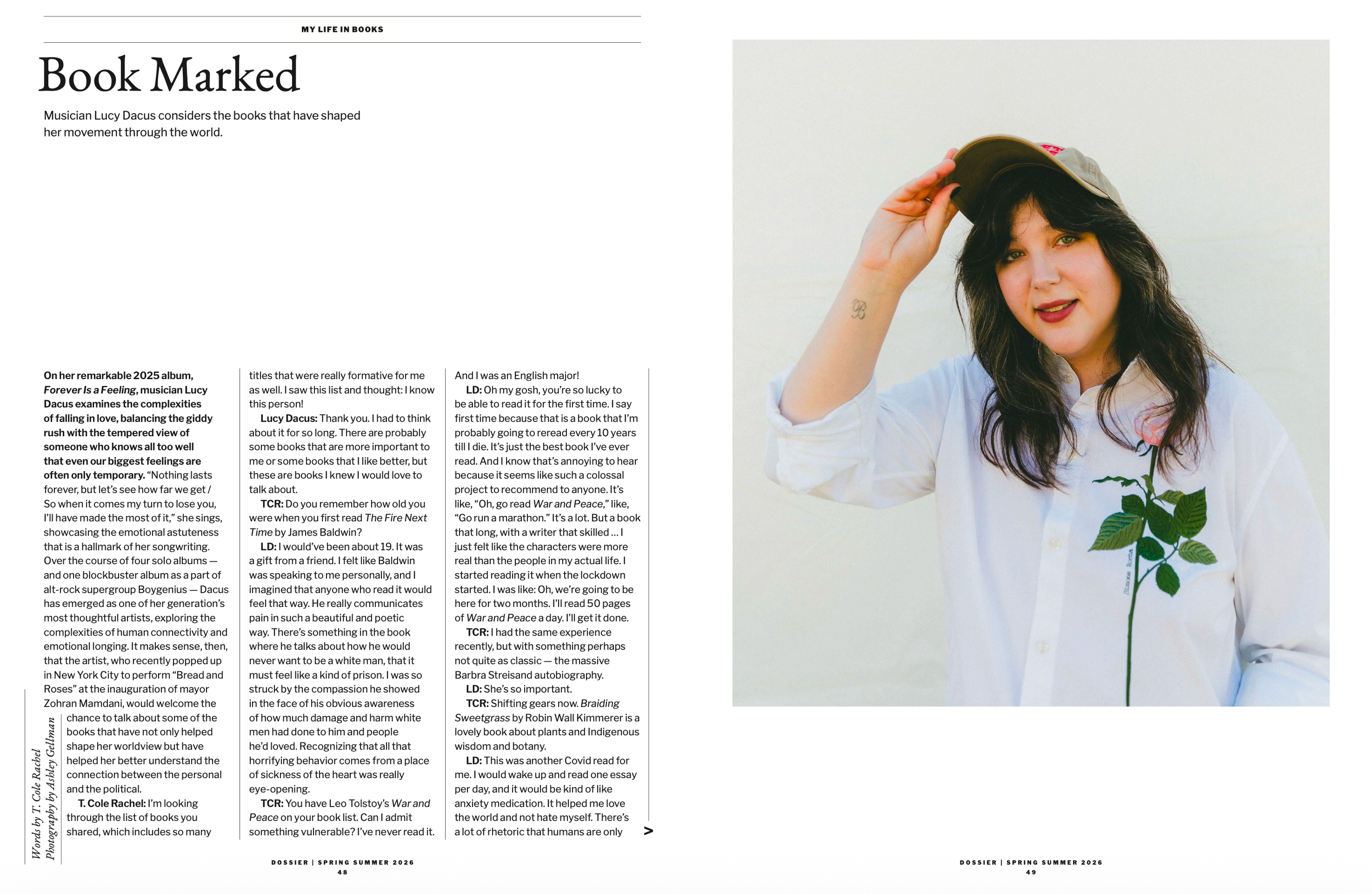
from the 2026 Spring/Summer issue of Dossier
Book Marked
Musician Lucy Dacus considers the books that have shaped her movement through the world.
On her remarkable 2025 album, Forever Is a Feeling, musician Lucy Dacus examines the complexities of falling in love, balancing the giddy rush with the tempered view of someone who knows all too well that even our biggest feelings are often only temporary. “Nothing lasts forever, but let’s see how far we get / So when it comes my turn to lose you, I’ll have made the most of it,” she sings, showcasing the emotional astuteness that is a hallmark of her songwriting. Over the course of four solo albums — and one blockbuster album as a part of alt-rock supergroup Boygenius — Dacus has emerged as one of her generation’s most thoughtful artists, exploring the complexities of human connectivity and emotional longing. It makes sense, then, that the artist, who recently popped up in New York City to perform “Bread and Roses” at the inauguration of mayor Zohran Mamdani, would welcome the chance to talk about some of the books that have not only helped shape her worldview but have helped her better understand the connection between the personal and the political.
T. Cole Rachel: I’m looking through the list of books you shared, which includes so many titles that were really formative for me as well. I saw this list and thought: I know this person!
Lucy Dacus: Thank you. I had to think about it for so long. There are probably some books that are more important to me or some books that I like better, but these are books I knew I would love to talk about.
TCR: Do you remember how old you were when you first read The Fire Next Time by James Baldwin?
LD: I would’ve been about 19. It was a gift from a friend. I felt like Baldwin was speaking to me personally, and I imagined that anyone who read it would feel that way. He really communicates pain in such a beautiful and poetic way. There’s something in the book where he talks about how he would never want to be a white man, that it must feel like a kind of prison. I was so struck by the compassion he showed in the face of his obvious awareness of how much damage and harm white men had done to him and people he’d loved. Recognizing that all that horrifying behavior comes from a place of sickness of the heart was really eye-opening.
TCR: You have Leo Tolstoy’s War and Peaceon your book list. Can I admit something vulnerable? I’ve never read it. And I was an English major!
LD: Oh my gosh, you’re so lucky to be able to read it for the first time. I say first time because that is a book that I’m probably going to reread every 10 years till I die. It’s just the best book I’ve ever read. And I know that’s annoying to hear, because it seems like such a colossal project to recommend to anyone. It’s like, “Oh, go read War and Peace,” like, “Go run a marathon.” It’s a lot. But a book that long, with a writer that skilled … I just felt like the characters were more real than the people in my actual life. I started reading it when the lockdown started. I was like: Oh, we’re going to be here for two months. I’ll read 50 pages of War and Peace a day. I’ll get it done.
TCR: I had the same experience recently, but with something perhaps not quite as classic — the massive Barbra Streisand autobiography.
LD: She’s so important.
TCR: Shifting gears now. Braiding Sweetgrass by Robin Wall Kimmerer is a lovely book about plants and Indigenous wisdom and botany.
LD: This was another Covid read for me. I would wake up and read one essay per day, and it would be kind of like anxiety medication. It helped me love the world and not hate myself. There’s a lot of rhetoric that humans are only a detriment to the planet. This book helped me see and appreciate all life a little more animatedly. And I just love the marriage of science and folklore and personal experience and poetry. It’s rare for a person to be so smart in one field and also so skilled in another.
TCR: You’ve included Sister Outsider by Audre Lorde, another book that was super important to me. I did an MFA in poetry, so I would always tell people to read the “Poetry Is Not a Luxury” essay from that book. I revisit that essay from time to time when I need something to sort of reset my brain.
LD: I love that essay. I have to remember that all the time, too. I sub out poetry for music and try to believe that this work is important. “The Uses of the Erotic,” essay shifted something inside me. That’s a before and after essay for me. It’s like a health essay — a reminder to connect back to your body and a way of widening the dichotomy of art versus porn.
TCR: Other than The Color Purple, I can’t think of another epistolary novel that worked as well as Gilead by Marilynne Robinson. You get everything through the prism of this one person, whose voice evolves over the course of the book.
LD: I read Gilead when I still called myself a Christian, and I was thinking a lot about what that really meant. I related so much to the narrator and his confusions and hopes and real desire to keep God in his life and be a good person. He knows that he is likely going to die before his son can grow up and really know him, so that is the pretext of the book. He’s writing it for his son to read later on, but as he goes on writing things, it becomes clear that it’s really for himself.
TCR: Another of your choices, Written on the Body by Jeanette Winterson, is also a pretty formative text for a lot of folks. I feel like everyone I know read this book at some point.
LD: I read it kind of recently, actually. It’s so passionate and visceral … but it’s passionate in a way that doesn’t even feel romantic sometimes. I appreciated that. It’s not just courtship and sweetness; it’s a little destructive or obsessive and layered. And the narrator is not hesitating to portray themselves as unloving. This new love they’ve found makes them reflect on everything that they have done before as kind of a failure. Plus, you have a narrator who is genderless, which adds a whole other layer.
TCR: It dovetails nicely with another book you chose, Wittgenstein’s Mistress by David Markson. It’s ostensibly a book about a woman who has come to believe she is the last person on Earth.
LD: I had an English teacher who would often recommend books to me or give me cool music to check out. He gave this book to me when I was 16. It was probably the first truly “experimental” book I had ever read. I have a dissociative streak and, in reflection, I think part of what captivated me so much is the way that this woman feels as if she, the last woman on Earth, is trying to tend to her memory because once she forgets things, then they’re gone from the universe forever. It married my fear of losing my memory and my experience of feeling completely alone.
TCR: You don’t have any other memoirs or biographies on your list, but Widow Basquiat by Jennifer Clementis a pretty fascinating addition. It’s a sort of a hybrid.
LD: The format was so moving to me. It is a book about a woman that was written by her best friend. I appreciated that Suzanne Mallouk would trust her friend to put her experience into words and poeticize things — that it was maybe easier to let her friend say it than to say it herself. A lot of people probably read it simply as [Jean-Michel] Basquiat fans, but the book is about this woman who was his partner. I’m sure it’s a very particular experience to go through life and for your main descriptor to other people to be about your proximity to this famous artist. To be able to have this book and really center the story on your own experience, I imagined it was really healing for her.
TCR: Well, last but certainly not least, Stone Butch Blues by Leslie Feinberg.For people unfamiliar, this is a novel from 1993 about the experience of a butch lesbian in the ’60s and ’70s, who must sometimes try to pass as a man in order to survive. It’s a brutal book but also very beautiful.
LD: Oh my God. I finished it only a couple days ago. And I was like: I’m putting this on the list. I don’t care. It is immediately in my top 10.
TCR: This book was published in the early ’90s, but it was so far ahead of its time in regard to what it says about gender and sexuality and identity. I feel like it couldn’t be any more important or relevant for our current moment.
LD: I couldn’t believe when it was written and the era that it’s written about — the ’60s and ’70s. Oh, I cried at every page. I feel so lucky that I don’t experience violence every day. You know, I’m very publicly in a specific relationship with a woman. And that, for the most part, is celebrated. There are bigots who threaten us, but they’re mostly online, and I can live my life without constant fear. I was reading a lot on planes and having to stop and weep. I have tons and tons of queer friends, and our reality is still very complicated, but also so much has changed.
From Dossier Magazine
Words by T. Cole Rachel